Best Solana RPC Providers (2026): A Full Comparison
Compare the best Solana RPC providers in 2026. Learn what matters, how pricing works, and how to choose the right one.

Choosing a Solana RPC provider in 2026 is still more complex than it should be.
Not because the technology is immature, but because the critical evaluation criteria like features and pricing are often misunderstood. The right provider for a wallet backend is rarely the right one for an arbitrage bot, and the right provider for an NFT indexer is different again.
This guide takes a developer-first approach:
- Clarifying the features that matter for Solana,
- Showing how to calculate real costs, and
- Walking through the top five providers worth considering in 2026.
Once those are clear, the choice of Solana RPC provider becomes simpler. Let's start.
Solana RPC Features: What Are They and What Actually Matters
Solana RPC providers surface a wide range of features, but most decisions come down to a small set of core variables that impact performance, reliability, and cost:
- Latency: Time for a node to respond to a request. Measured as p50, p95, or p99. On Solana, this matters more than on most chains because of how state access works under the hood.
- Throughput: Requests per second a provider allows before rate-limiting kicks in. Solana's RPS caps are often tighter than EVM equivalents because every read is a disk operation against live state.
- Uptime / SLA: Guaranteed availability, expressed as a percentage. 99.9% = ~8.7 hours of downtime per year. 99.99% = ~52 minutes.
- Archive vs Full Node Access: A validator-backed Solana node only retains the last ~4 days of history. Anything older falls through to a provider-operated archival tier (BigTable, custom backends). This is why deep-history methods are often restricted or surcharged.
- API Credits / Compute Units (CUs): Unit for measuring request cost. The catch is that providers weight methods very differently.
- Transaction Submission Path: sendTransaction doesn't guarantee inclusion. Landing depends on the provider's peering, stake-weighted routing (SWQoS), and Jito integrations. This is where providers differentiate most aggressively.
- Dedicated vs Shared Nodes: Shared nodes pool resources across customers. Dedicated nodes offer isolated, predictable performance.
- Compliance Certifications: SOC 2 Type II, SOC 1, ISO 27001. Critical for fintech, payments, and regulated consumer rails.
These features set the baseline for picking an RPC provider.
Where teams consistently get caught off guard, however, is pricing. Specifically because of providers packaging and billing for these features in ways that make direct comparison harder than it needs to be.
So, let's break down how to actually calculate Solana RPC costs.
How to Actually Calculate Solana RPC Costs
Most Solana RPC providers price in one of three models:
- Per-request credits: 1 method call = 1 credit, regardless of cost.
- Compute Units (CUs): Each method weighted by its infrastructure cost.
- Flat-fee / unlimited: Fixed monthly rate, RPS-capped.
Outside all these, there are providers who bundle limits into tiered plans.
At first glance, this seems comparable. In practice, it isn't because of a simple problem: 1 request ≠ 1 request across providers.
A lightweight call like getAccountInfo and a heavy call like getProgramAccounts are both single requests but they can cost wildly different amounts. getProgramAccounts can consume 1 credit on one provider and 20x a getAccountInfo on another.
Normalization Formula to Calculate Solana RPC Costs
The only way to compare providers fairly is to normalize cost per actual method call:
- True cost per call = (CU weight of method × price per million CUs) ÷ 1,000,000
- Total cost = true cost per call × total call volume
- Monthly cost = true cost per call × monthly call volume
Where, cost per call = API credits or compute units consumed per method, specific to the provider.
A Working Example of Calculating Solana RPC Costs
Assume a Solana app making 10 million getAccountInfo requests per month across two providers:
For light single-method workloads, Helius is cheaper per call. But swap getAccountInfo for getProgramAccounts (which Helius weights at 10 credits) or add archive queries and the math flips quickly. Effective cost depends on the workload mix, not the sticker price.
Now that the terminology is clear and cost can be normalized across providers, the comparison becomes much more straightforward.
Here's how the top Solana RPC providers in 2026 stack up across these same variables.
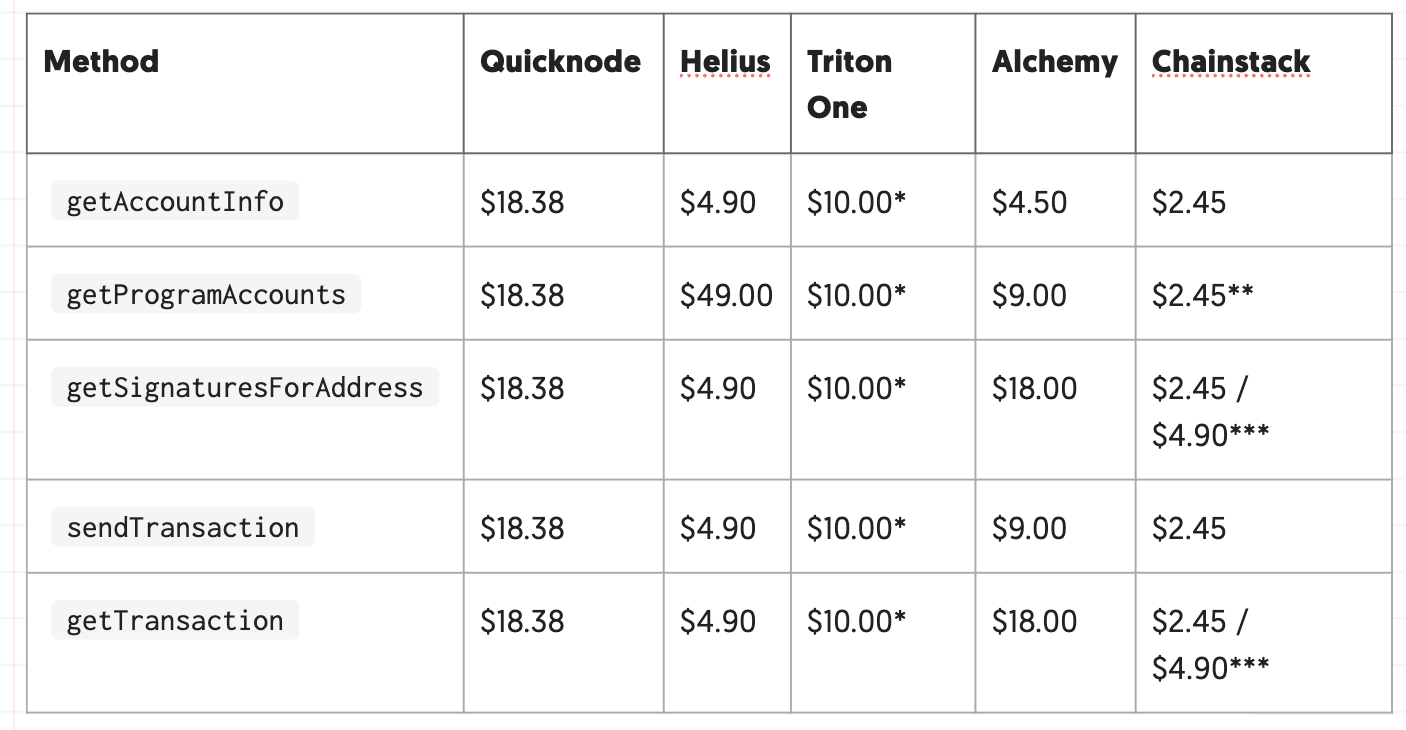
True Cost Per 1M Calls: Solana RPC Providers Compared
The following table applies the normalization formula to five of the most-used Solana RPC methods across every provider in this comparison. Prices reflect each provider's standard paid entry tier (not Enterprise) and are rounded for readability. Lower numbers are better.
Notes:
- *Triton One: Triton prices by bucket ($10/M calls for Standard RPC or $25/M for historical ledger) plus bandwidth costs. Only base cost is shown here since bandwidth charges depend on response size.
- **Chainstack: Depending on timeline, this can be called at normal rate at 1 RU ($2.45) or at archive pricing at 2 RUs ($4.90).
- ***Chainstack: Archive pricing (2 RUs) applies for older data.
Takeaway: Raw credit cost is only part of the picture. Flat-request models compress every method to the same line item, which reads as cheap at the entry tier but quietly shifts the cost of heavy scans, deep-history queries, and high-bandwidth streams into RPS caps and overage fees. That's why the same method can vary 5–10x in cost or latency across providers.
Quicknode delivers a deep stack across every dimension that matters: competitive per-method pricing on the workloads Solana apps actually run, the only full compliance posture in this comparison (SOC 1 + SOC 2 Type II + ISO 27001), 99.99% contractual uptime SLAs on Dedicated and Enterprise plans, and built-in Streams for workloads where polling would otherwise balloon cost. On production reliability, platform depth, and effective cost once real workload patterns and data infrastructure needs are factored in, Quicknode covers the most ground.
Quicknode: Most Complete and High-Performant RPC Stack
Quicknode has been building blockchain infrastructure since 2017. Today, it's a global web3 infrastructure platform with deep Solana-specific tooling and the widest enterprise footprint of any provider in this comparison. What separates it from a pure RPC provider is the platform layer on top: Streams for real-time data pipelines, native Solana tooling (Lil'JIT, Yellowstone gRPC, Transaction Fastlane), and the most compliant RPC stack on the market.
What Quicknode Does Well
- High-performant and reliable infrastructure
Most providers look fast in ideal conditions. The difference shows up at p99 when requests stack up, retries pile in, and bots start missing slots.
Quicknode is faster and consistent at p95/p99 under load. 99.99% uptime is backed by contractual SLAs on Dedicated and Enterprise plans.
- Streams compresses all Solana data needs into one pipeline
Most teams start with RPC and slowly realize they're building a data pipeline on top of it. Quicknode compresses that with Streams: one pipeline of filtered, pushed data with backfill and reorg handling baked in, at a fraction of an otherwise manual credit burn.
- Deepest Solana-native tooling
Lil'JIT (Jito bundles), Metis (Jupiter Swap), Solana Priority Fee API, Yellowstone gRPC, Pump Fun API, and Transaction Fastlane. Each one is configurable on top of the core RPC and solves a specific Solana problem, with no Pro-tier paywall hiding the good stuff.
- Full compliance stack
SOC 2 Type II + SOC 1 + ISO 27001. Quicknode is the only provider in this comparison certified across all three, audited by Grant Thornton and recertified in Q1 2026. For fintech, payments, and regulated consumer rails, that compliance combination is hard to match elsewhere in this space.
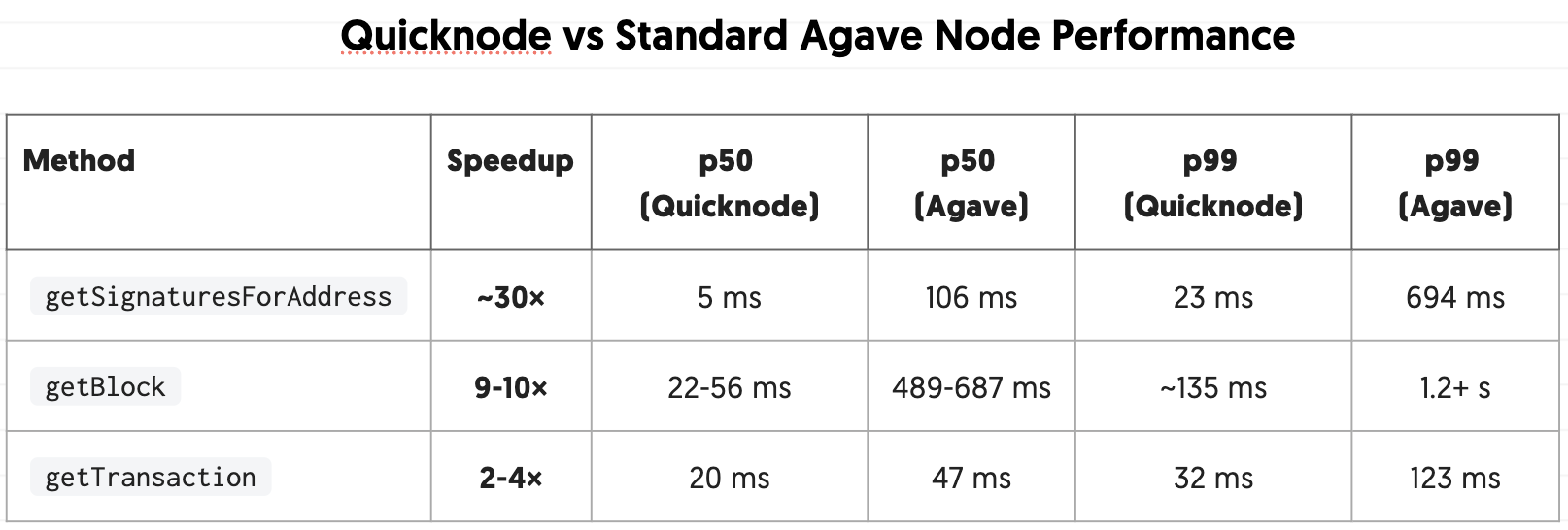
Performance in Practice: Quicknode vs Agave
Here's a snippet of RPC performance when Quicknode is stacked against a standard Agave node on methods that dominate production workloads:
Key takeaways:
- Quicknode's Solana RPC delivers measurably lower latency than a standard Agave node across all measured methods.
- One Quicknode cache node sustains ~5000 RPS on getBlock vs Agave's ~130 RPS, which is ~38x more requests before latencies degrade.
Quicknode Solana RPC Pricing
Quicknode bills on API credits.
All standard Solana RPC methods are priced at 30 credits per call. Advanced APIs and Large Calls sit in 2x and 4x buckets. Overage runs $0.62/1M credits on Build down to $0.50/1M on Business. Annual billing saves 15% across tiers.
Bonus: Quicknode in March 2026 launched Flat Rate RPS, available across EVM chains (Ethereum, Base, Optimism, Arbitrum, BSC, Polygon) and Solana mainnet. Fixed monthly cost, no credit metering, no overage risk. Solana endpoints use a 1.5x pricing multiplier given the higher resource requirements.
Considerations
- Entry-tier credit weight is higher than flat-rate alternatives. At 30 credits per call across all standard Solana methods, Quicknode is the highest entry-tier rate in this comparison on a single-method basis. Once normalized against real workload patterns (which mix reads, history, and submission), effective cost typically lands competitive.
- No ongoing free tier. Quicknode offers a 1-month trial credit allotment, not a permanent free plan. For pure prototyping, Quicknode has a higher entry barrier than Alchemy or Helius.
Best for
- Production systems with mixed workloads (reads + history + transactions).
- Latency-sensitive applications where tail performance matters: trading infra, real-time dashboards, anything user-facing.
- Fintech, payments, and institutional builds that need the full compliance stack.
- Multi-chain teams that want one platform across 60+ chains.
We have covered all things Quicknode. Let's move onto other Solana RPC providers.
Helius
Helius is Solana-only by design. Every product, every API, every infrastructure decision is shaped by Solana's specific architecture, and it shows in the depth of their Solana-native tooling.
What Helius Does Well
- Flexible transaction submission paths
Helius separates transaction delivery into multiple paths (standard, staked connections, Sender). This gives users control over cost vs landing guarantees, and Sender submits in parallel to Jito and Helius across 7 regions with tip-only billing.
- Aggressive pricing for standard RPC calls
Most standard methods (getAccountInfo, getTransaction) sit at 1 credit per call, making Helius one of the cheapest options for common read-heavy workloads.
- Validator-backed staked sending
Helius runs a substantial Solana validator with real stake, and that stake feeds directly into transaction-landing performance via stake-weighted QoS.
Helius Solana RPC Pricing
Notes:
- Standard RPC methods price at 1 credit per call but getProgramAccounts is 10 credits, reflecting the real infrastructure cost of unbounded scans.
- LaserStream mainnet gRPC is gated to Business and Professional (Devnet is available on Developer). Enhanced WebSockets are available on paid plans starting at Developer.
Tradeoffs to Consider
- Pricing breaks on heavy or complex queries. Methods like getProgramAccounts are 10x more expensive. Any workload that leans into wide scans or indexing-like behavior, the costs can scale quickly.
- Free tier is genuinely small at 1M credits and 10 RPS. Not enough to run anything in production.
- Single-chain only. If the roadmap includes EVM, L2s, or alt-L1s, a second provider relationship is required.
- Compliance posture is limited. SOC 2 only. No SOC 1, no ISO 27001.
Best for
Read-heavy Solana-only applications: wallets, dashboards, analytics tools with predictable query patterns. And for builders optimizing for cost on simple RPC calls, as long as the workload stays within standard patterns.
Triton One
Triton One gives teams direct, high-throughput access to Solana with minimal opinion and filter. As an infrastructure-first provider, Triton offers raw access, high performance, and fewer layers. They don't participate in abstract bundling plays like other providers.
Did you know? Triton One authored and built Yellowstone-gRPC, the streaming backbone that powers nearly every Geyser deployment in the Solana market.
What Triton One Does Well
- Stake-weighted sending by default
Every Triton customer now sends through staked connections at no extra cost. This is the most builder-friendly pricing change the SWQoS market has seen.
- Strong support for data-heavy workloads
Large responses (getProgramAccounts, getTransaction, block queries) are handled well because Triton employs Old Faithful, a content-addressable archive of Solana's full ledger from genesis. For teams building indexers, analytics pipelines, or forensic tooling, Triton is the deepest history provider available.
- Open-source by default
Triton is a giant in open-source production of Solana infrastructure: Yellowstone-gRPC, Old Faithful, Steamboat (custom getProgramAccounts indexes), Vixen (pre-parsed program data), Jet (transaction relay), and Fumarole (persistent gRPC with consumer groups and replay). All open-source, all Triton-authored, all running in production at competitors who use them and at teams who self-host. Vendor lock-in, which is a headache with some other providers, doesn't apply here.
Triton One Solana RPC Pricing
How to read this pricing:
- Triton's pricing is two costs added together: a per-million-call rate that varies by API category, plus $0.08/GB of bandwidth that applies to everything.
- Simple PAYG and Custom PAYG charge identical rates, but Custom PAYG lets teams allocate their prepaid balance across services manually instead of drawing from a shared pool.
- Dedicated Nodes are an entirely different model: pay a flat monthly fee, get isolated infrastructure, and stop counting per-call costs.
Tradeoffs to Consider
- Bandwidth makes pricing non-linear. The $10/M number looks clean. But once responses get large (blocks, transactions, program scans), bandwidth becomes the real cost driver.
- Lack of development integrations and add-ons. Triton offers raw access to Solana data and nothing beyond. No parsed APIs. No built-in indexing. No higher-level product layer for things like Jito bundling, swap routing, or priority fee estimation.
- Developer experience is leaner than peers. Triton assumes every user wants raw RPC access and is willing to build every other part of the stack individually. Teams that want a polished operator experience will feel the gap.
- No public compliance certifications. Not a fit for regulated deployments.
Best for
- Teams that take infrastructure seriously enough to read protocol specs and know which version of Yellowstone they're running.
- Indexers, data platforms, and analytics providers where archival depth and gRPC reliability are existential.
- Anyone planning to self-host eventually who wants the option preserved.
Alchemy
Alchemy is a fairly newer entrant to the Solana RPC market compared to its peers. The dual acquisition of Bware Labs (which built Blast API) and DexterLab (Solana-native archival specialists) changed the way Alchemy supports Solana developers.
What Alchemy Does Well
- Best-in-class archival
Alchemy employs a multi-region HBase architecture of small microservices that restart in seconds rather than the 30+ minutes BigTable needs.
- The most generous free tier in this comparison
30M Compute Units per month at $0 is enough to prototype, develop, and run small production workloads without committing.
- Strong developer tooling and UX
Alchemy leans heavily into developer experience with dashboards, debugging, logs, and SDKs. The company has been operating at scale across chains for years, and the Solana offering benefits from that maturity, particularly in tooling, monitoring, and support.
Alchemy Solana RPC Pricing
Notes:
- Alchemy's pricing reflects method complexity instead of payload size. Simple methods stay cheap, expensive methods scale fast.
- Yellowstone gRPC streaming is gated to PAYG+ and bills at $80/TB streamed.
Tradeoffs to Consider
- Lack of Solana-native depth. Alchemy still has work to do on Solana-specific infra. DAS is in Beta. Webhooks for Solana addresses are in early Beta.
- CU model penalizes history-heavy workloads. getTransaction and getSignaturesForAddress at 40 CU each mean indexers and analytics platforms pay disproportionately.
- Propagation paths are underspecified. Alchemy markets staked connections but publishes no validator stake weight, and there's no first-party sendBundle equivalent like Lil'JIT or Sender. For latency-sensitive or MEV-style workflows, Alchemy can be a hassle.
- Incomplete compliance posture. SOC 2 Type II only. No SOC 1, no ISO 27001.
Best for
Multi-chain teams whose Solana work is one of several priorities and who already use Alchemy on EVM. Wallet applications and consumer apps where the read mix is dominated by getAccountInfo and balance lookups, not transaction submission.
Chainstack
Chainstack offers simple deployment, infrastructure-first access with predictable limits, and cost clarity. It is still a serious Solana RPC provider, with Yellowstone gRPC, ShredStreams, and dedicated nodes available.
What Chainstack Does Well
- The cleanest pricing in this comparison
1 Request Unit per call across all standard methods, no per-method multipliers, no surprise CU weights. Growth at $49/mo includes 20M RUs and is the lowest entry-tier rate in this comparison. Chainstack's standalone gRPC tier is also the cheapest credible streaming option in the market.
- Unlimited Node for predictable high-volume workloads
A flat-fee, unmetered RPC product starting at $149/mo for 25 RPS, scaling to 100/250/500 RPS.
- SOC 2 Type II certified
Chainstack's Solana offerings are SOC 2 Type II certified, which clears the basic compliance box for many regulated workloads.
Chainstack Solana RPC Pricing
Notes:
- Every request is equal apart from archive data and advanced usage, which are 2 RUs.
- Overage ranges from $20/1M RU (Developer) down to $5/1M RU (Enterprise).
Tradeoffs to Consider
- Solana-specific depth is lacking. No DAS API. No first-party Jito bundle submission. No transaction-landing service. The Solana-native product surface is narrower than peers.
- RPS caps tighten on Solana relative to advertised numbers. Chainstack's published RPS figures are EVM-friendly. On Solana, the practical cap is lower, which matters for any workload that bursts.
- No built-in data layer or indexing. Teams that need real-time filtered delivery build that layer themselves on top of RPC.
Best for
- Developers who want a clean RPC endpoint without extra layers.
- Cost-sensitive teams who want SOC 2 compliance without enterprise pricing.
- Indexers, analytics platforms, and data layers that need Yellowstone gRPC at a sub-$100/mo price point.
Now that we have covered all 5 top Solana RPC providers in detail, let's see how they stack against each other.
Top 5 Solana RPC Providers at a Glance
The table below distills each provider's positioning, pricing model, and best-fit workload into a single view.
Which Solana RPC Provider for Your Use Case?
Different workloads have different priorities. Here's how the top providers map to common use cases.
DeFi protocols and trading bots
Quicknode, Helius. Trading economics live and die on transaction landing. Quicknode's Transaction Fastlane and Lil'JIT for Jito bundles cover the full submission stack with the configurability most desks need. Helius Sender is the alternative for teams whose unit economics demand parallel submission across Jito and staked connections in 7 regions, billed tip-only.
Early-stage teams and startups
Quicknode, Alchemy. Quicknode's Build tier ($49/mo, 80M credits) gives small teams enough headroom to ship and iterate without immediate scaling anxiety, plus core Solana products like Streams available on the platform and add-ons like Yellowstone gRPC, Lil'JIT, and Transaction Fastlane available a la carte as the stack grows. Alchemy's 30M-CU free tier is the alternative for teams who want to prototype against a permanent free plan before paying anything.
NFT platforms and wallets
Quicknode, Helius. Quicknode ships DAS, parsed transactions, and webhooks alongside the multi-chain reach most consumer-facing teams need. Helius is the alternative for teams committed to Solana-only and willing to trade multi-chain support for the deepest cNFT and ZK Compression primitives.
High-volume data pipelines and indexers
Quicknode Streams, Triton One. Quicknode Streams is the most cost-effective path for production-grade data layers. Replacing polling with push-based delivery reduces redundant calls, engineering overhead, and effective cost more than any per-call discount can. Triton is the alternative for teams whose workloads justify Yellowstone-gRPC with Fumarole replay or Old Faithful archival access.
Enterprise and regulated applications
Quicknode. SOC 2 Type II + SOC 1 + ISO 27001 is the only certification combination in this comparison that clears full enterprise procurement, audited by Grant Thornton and recertified in Q1 2026. For fintech, payments, institutional, and regulated consumer rails, that compliance combination matters more than per-call pricing.
Cross-chain and multi-chain applications
Quicknode. Single-provider coverage across 60+ chains means one platform for auth, billing, monitoring, and compliance. Teams building multi-chain applications avoid the operational overhead of managing multiple RPC relationships and the reliability risk of mixed infrastructure quality.
Frequently Asked Questions (FAQs)
- Which is the best Solana RPC provider?
There's no single best. It depends on the workload. Quicknode is a strong default for production use cases due to consistent latency, reliability under load, full compliance posture, and built-in data infrastructure like Streams.
- How do I choose a Solana RPC provider?
Match the provider's infrastructure depth and pricing model to the workload: reads, writes, history, or streaming. Quicknode covers the broadest set with the deepest native Solana tooling.
- What affects Solana RPC performance the most?
Indexing strategy, capacity planning, and how the provider handles state, history, and transaction submission under load. Solana RPC reads are I/O-bound disk operations against live state, not lightweight API calls, so provider infrastructure choices show up directly in p95 and p99 latency.
- Why do Solana RPC providers have different pricing?
They price different things (requests, compute, or bandwidth) based on how they handle infrastructure under the hood. Two providers advertising the same $/M rate can produce a 5–10x difference in actual monthly spend once method weighting and workload mix are factored in.
- What are stake-weighted connections (SWQoS)?
A Solana mechanism prioritizing transactions from RPC nodes with delegated stake, improving landing rates during congestion. Quicknode (Transaction Fastlane + Lil'JIT), Helius (Sender), and Triton (Jet) all offer first-party staked submission paths.
- Which Solana RPC providers are SOC 2 certified?
Quicknode is the only provider in this comparison certified across all three (SOC 2 Type II + SOC 1 + ISO 27001), audited by Grant Thornton and recertified in Q1 2026. Alchemy and Chainstack hold SOC 2 Type II certifications.
- Who is the cheapest Solana RPC provider in 2026?
Chainstack's Growth plan at $49/mo for 20M RUs works out to an amortized $2.45 per 1M calls at full quota utilization, the cheapest entry-tier rate in this comparison on a like-for-like single-method basis. Marginal overage on Growth runs $15/M RU, so the true cost depends on whether usage stays within the included quota. And the cheapest sticker price is rarely the cheapest total cost. Effective cost depends on method weighting against real workload patterns, how much polling and indexing infrastructure has to be built on top, and what uptime and reliability cost in production incidents.
- Do I need a dedicated node, or can I use a shared RPC provider?
Shared infrastructure works fine for startups and small projects. Dedicated nodes, available across Quicknode's tiers, make sense for latency isolation, predictable performance, or compliance requirements.
- Which Solana RPC providers support Jito bundles?
Quicknode (Lil'JIT), Helius (Sender), and Triton (Jet) offer first-party Jito bundle submission. Alchemy and Chainstack do not currently provide native bundle submission.
- Can I run my own Solana RPC node?
Yes, but it requires 512 GB+ RAM, multi-TB enterprise NVMe (separate physical devices for accounts and ledger), 10 Gbps network capacity, and roughly $10–15k/mo for an HA deployment, before factoring in engineering time.
About Quicknode
Founded in 2017, Quicknode provides world-class blockchain infrastructure to developers and enterprises. With 99.99% uptime, support for 80+ blockchains, and performance trusted by industry leaders, we empower builders to deploy and scale next-generation applications across Web3.
Start building today at Quicknode.com.