What is HIP-4? Hyperliquid Outcome Contracts Explained
Learn how HIP-4 and outcome contracts work, explore composability with the rest of Hyperliquid stack, and how developers can build on this.

Hyperliquid has spent two years building toward a single thesis:
Every financial market: crypto, equities, commodities, events should run on the same execution engine, with shared liquidity and composable margin.
Each proposal and action in terms of HIPs (Hyperliquid Improvement Proposals) is continually expanding the surface area of what's tradable on HyperCore.
- First, HIP-1 gave the chain native tokens.
- Then, HIP-2 bootstrapped liquidity.
- Last year (2025), HIP-3 opened perpetual futures to permissionless deployment.
Just days ago, HIP-4 went live on Hyperliquid testnet, and it expands Hyperliquid into a new design space and market mechanics with outcome contracts.
What is it? Is it simply “prediction markets on Hyperliquid”? How does it work?
Let’s answer each question with a breakdown of the primitives HIP-4 introduces and how they fit within the overall Hyperliquid infrastructure.
HIP-4 as a Primitive: What are Outcome Contracts?
Outcome contracts are binary financial instruments on Hyperliquid tied to whether a specific event occurs. They trade between 0 and 1, where the price represents the market’s implied probability of that event occurring.
- If the event happens, the contract settles at 1.
- If it doesn't, it settles at 0.
Because the settlement values are fixed, the payoff structure is straightforward.
The Layman’s Math of Outcome Contracts
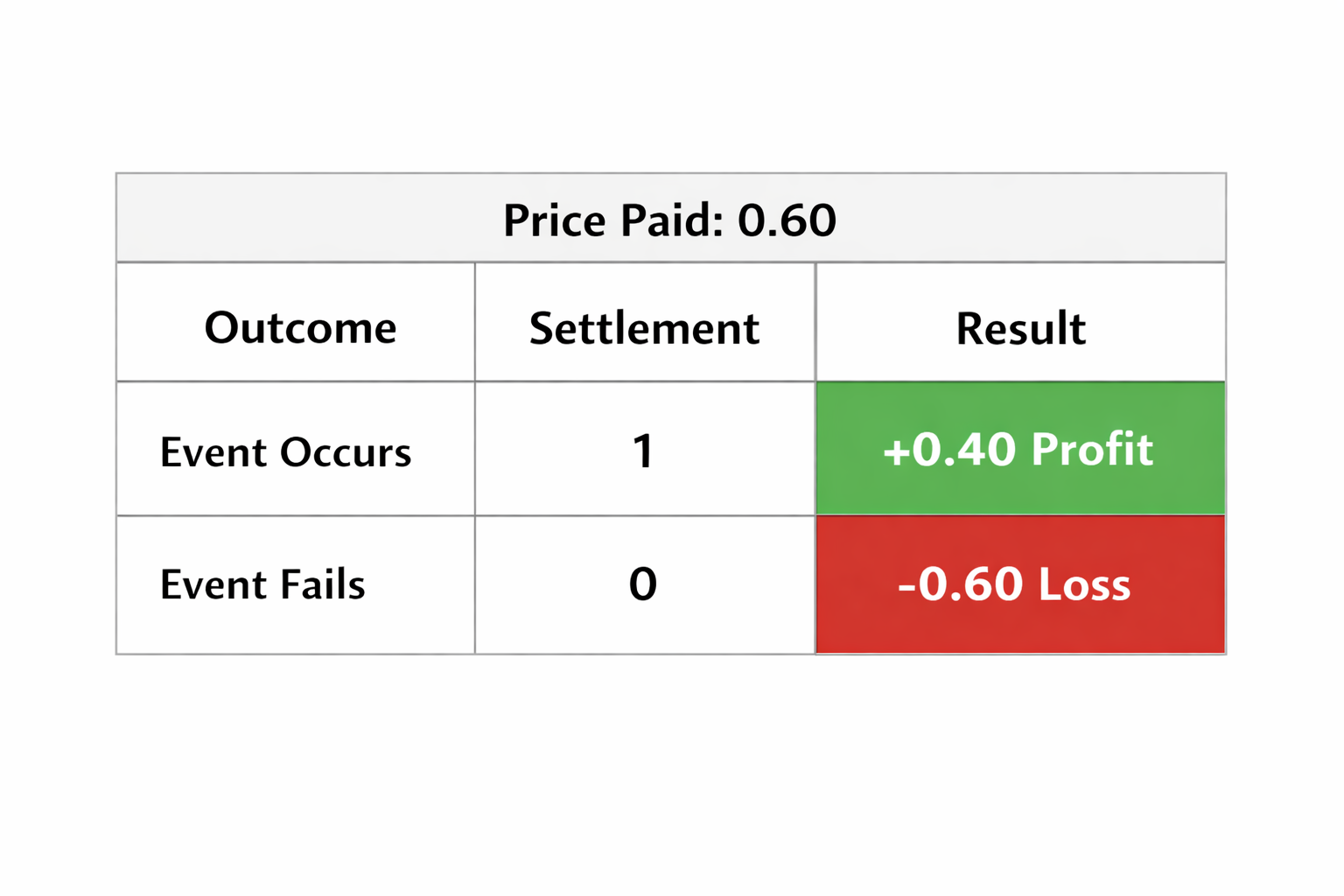
Assume a trader buys a YES contract at price P, the payoff at settlement is:
- Profit if event occurs: 1−P
- Loss if event does not occur: P
Example:
If a contract trades at 0.60, the market is implying a 60% probability that the event will occur. And here’s the scenario if a trader buys YES at 0.60:
Math, money, and payoffs aside, understanding how outcome contracts behave and what becomes possible because of it requires a little more depth.
Outcome Contracts Inside HyperCore
Outcome contracts run directly inside HyperCore, the core execution layer responsible for spot and perpetual markets on Hyperliquid. Meaning, they use the same onchain orderbook infrastructure, matching engine, and trading environment that existing markets use.
- Order book: Every outcome market gets its own central limit order book (CLOB), operating the same as spot and perp markets operate on HyperCore.
- Account system: Outcome contract positions live inside the same Hyperliquid trading account that a trader uses for Hyperliquid DEX.
Outcome contracts being native to HyperCore also makes life easier for builders and developers looking to innovate within the Hyperliquid ecosystem.
Because outcome contracts inherit the same infrastructure as any other HyperCore market in terms of:
- transaction throughput,
- latency profile,
- validator set handling finality, and more.
This way, builders querying outcome market state, order book depth, or settlement events can use the same infrastructure they'd use for Hyperliquid DEX.
The next step is understanding how these markets actually operate once they are deployed.
How Outcome Markets Work on Hyperliquid
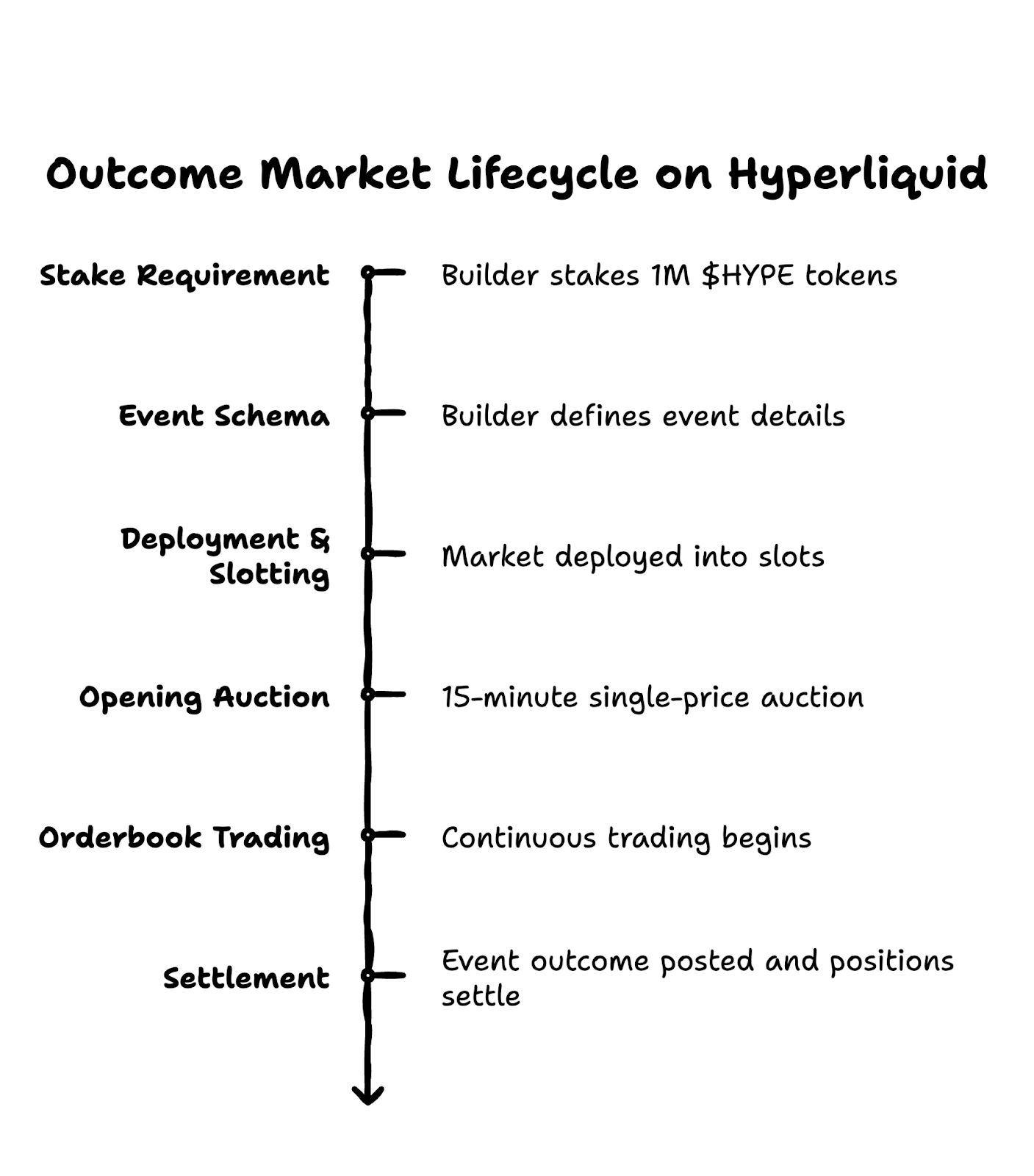
Once deployed inside HyperCore, outcome contracts follow a simple lifecycle: creation > auction > continuous trading > settlement.
While the process seems self-explanatory, there’s a nuance to each step that helps Hyperliquid maximize this market offering:
Stake Requirement
The builder (deployer) must stake 1M $HYPE tokens to deploy their outcome market.
The stake is slashable if a builder attempts to manipulate the oracle or to trigger invalid state transitions. Any partial or fully slashed $HYPE will be burned.
Event Schema
During deployment, the builder defines the event schema:
- Event title
- Resolution time
- Resolution source
- Authorized oracle updater
Optional addition: Challenge window for optimistic early resolution + disputes
Also, deployers can set an additional fee share of up to 50% on top of Hyperliquid's base fees.
Deployment & Slotting
Markets are deployed into slots within a builder’s event DEX.
Once resolved, the slot can be recycled with a new event, meaning a single 1M $HYPE commitment can support a rolling series of markets.
Opening Auction
After deployment, a ~15-minute single-price clearing auction runs, during which users submit orders (“buy YES up to price P”).
Remember, nothing executes in this phase.
When it closes, the engine picks the clearing price that maximizes matched volume, and every matched order fills at that single price.
Unfilled orders carry into continuous trading at their original limits.
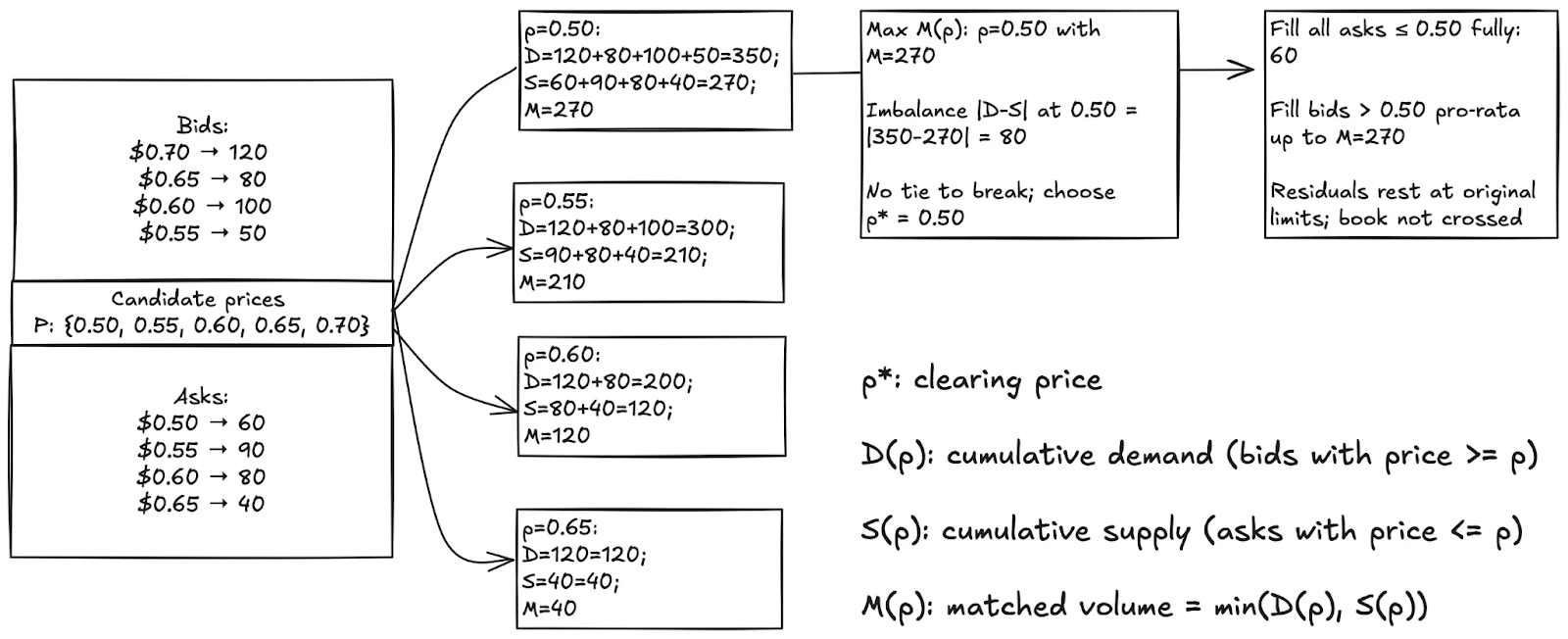
The actual math behind determining the opening price. Source
Orderbook Trading
After the auction, the market transitions to continuous orderbook trading.
Orders follow price-time priority. Traders can submit limit and market orders just like in other Hyperliquid markets.
The contract price reflects the market’s implied probability of the event occurring and remains bounded between 0.001 and 0.999 until the event resolves.
Settlement
When the event resolves, the authorized oracle posts the final outcome:
- 1 if the event occurs
- 0 if it does not
Trading halts, open orders are canceled, and all positions settle automatically to their final PnL in USDH.
Markets may optionally include a challenge window, allowing oracle outputs to be disputed before settlement becomes final.
Now, we know how the outcome markets work, the math, and the process. Let’s pivot to understanding why this matters for Hyperliquid as an ecosystem and for all participants within it.
The Composability Thesis: Hyperliquid as a Global Financial Execution Layer
Hyperliquid’s roadmap has been consistent from the start: expand the surface area for trading within a single execution engine.
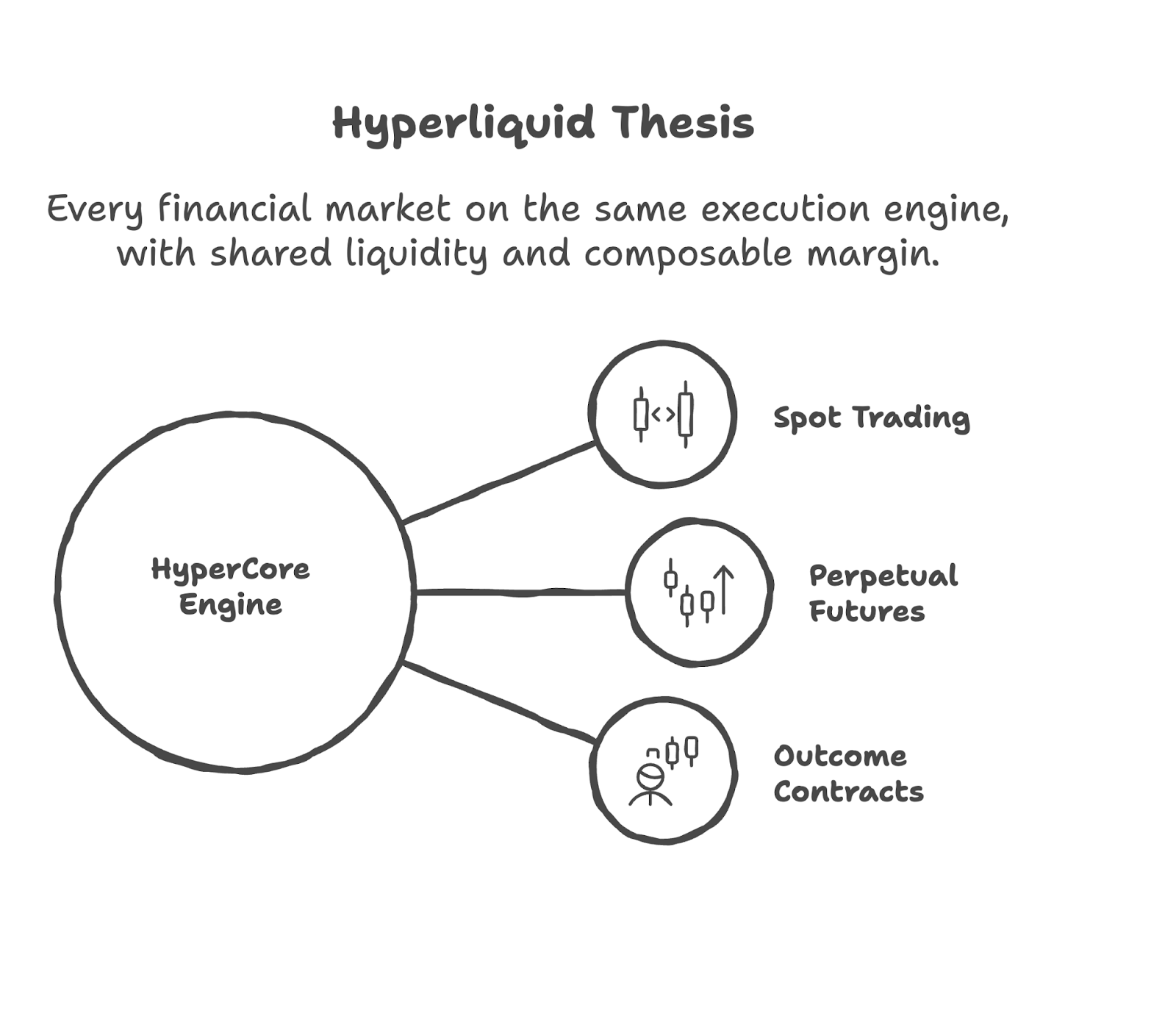
The idea is simple.
It's building a single execution layer where every market type — spot, perpetuals, and now outcome contracts — runs on the same infrastructure, settles through the same engine, and sits inside the same trading account. More importantly, every new market type deepens the same liquidity pool rather than fragmenting it.
That last part is what composability actually means here.
Consider a concrete example: a trader holds a long ETH perpetual. They believe ETH rallies if the Fed cuts rates, but want protection if it doesn't.
Anywhere else, the trader would need to take two separate positions on two separate platforms, each with its own collateral pool.
On Hyperliquid, the perp and the outcome contract sit in the same account.
Alternatively, this composability carries advantages for builders and developers alike:
- A market maker active in spot can extend their infrastructure to outcome markets without a new integration.
- Builders looking at Hyperliquid get unlimited design space which used to require multiple institution-grade infrastructure before and a lot of coordination in between to make it work.
Well, this isn’t a new experiment that Hyperliquid did. They have been at the same goal all along.
Hyperliquid has been very explicit regarding their long-term vision.
The Blockchain To House All Finance: A single blockchain capable of hosting every financial market on one execution layer.
Now, composability is only as useful as the builders innovating on it. Let’s think more practically about builders and operators on Hyperliquid.
What HIP-4 Changes for Builders, Liquidity Providers, and Market Creators on Hyperliquid
HIP-4 doesn't affect everyone on Hyperliquid equally. Let's zoom out and think of implications for the major 2-3 roles onchain.
Builders
For builders, HIP-4 turns event markets into deployable infrastructure rather than standalone applications. This opens room for new types of products:
- Cross-market arbitrage bots
- Event trading interfaces
- Layered structured products
- Market analytics and probability data products
- Prediction market frontends
Since the infrastructure is purpose-built and reliable, builders can build a wide range of interfaces and market-discovery layers on top of outcome contracts.
Liquidity Providers
For liquidity providers and market makers, outcome markets currently offer limited functionalities. Bounded payoff is a turnoff for any LP looking to maximize gains.
Also, outcome markets as probability instruments are more passive compared to perp markets for LPs where exposure is continuous and funding rates drive position decisions, increasing the profit ceiling.
Maybe, over time, this could lead to an entirely new liquidity category on Hyperliquid: event-probability market-making.
LPs and market makers don’t gain a direct win-win from HIP-4.
Market Creators
The 1M $HYPE stake is the barrier. At current prices, that's a significant capital commitment, but slot recycling changes the unit economics meaningfully.
A single stake supporting a rolling series of markets amortizes that cost over time.
This enables deployers to operate rolling event markets around recurring events such as:
- macroeconomic releases
- earnings announcements
- elections or governance votes
- major product launches
So, market creators have to think about slot utilization, sequencing market rollouts, and market timing far more than whether to stake a million $HYPE.
What next? Builders need good tooling and data access to genuinely leverage the new design space of outcome markets.
Why Infrastructure Matters for Outcome Markets
Outcome markets are event-driven.
A simple statement but this architectural distinction has direct implications that don't exist in continuous markets like spot or perpetuals.
> In a perpetual market, a missed update means a slightly stale price.
> In an outcome market, a missed event means a broken interface, a failed hedge, or a position that didn't settle correctly.
The cost of infrastructure failure is asymmetric.
For builders and traders interacting with these markets, that behavior raises the importance of reliable infrastructure. Applications need consistent access to:
- real-time orderbook data
- market state and event metadata
- account balances and position updates
- transaction submission for orders and cancellations
Because outcome markets trade on HyperCore’s orderbook, these interactions happen through RPC endpoints and APIs that expose market data and execution interfaces.
In practice, builders developing event trading interfaces, analytics dashboards, or automated strategies need infrastructure that can reliably handle spikes in activity when new information hits the market.
This is where infrastructure providers such as Quicknode become useful.
Building on Hyperliquid with Quicknode
By offering managed Hyperliquid RPC endpoints, data access, and developer tooling, Quicknode allows teams to focus strictly on building products and solutions.
Quicknode's HyperCore integration, which is currently in public beta, promises to carry infra superpowers like:
- Streams support for Hypercore datasets, enabling filtered, push-based delivery of Hyperliquid data
- gRPC APIs designed for high-volume, low-latency data pipelines
- JSON-RPC and WebSocket-related methods for compatibility with existing workflows
More Quicknode resources for Hyperliquid builders:
- Hyperliquid API Overview | Quicknode Docs
- Build a Real-Time Hyperliquid Whale Alert Bot
- Read HyperCore Oracle Prices in HyperEVM
- Real-time risk monitoring and liquidation analytics API for HyperLend Protocol on Hyperliquid
- Comparison of the top 6 Hyperliquid RPC providers for HyperCore and HyperEVM
SDKs & Tools
- Hyperliquid Python SDK — also on PyPI
- Hyperliquid API Examples — clone-and-run examples in Python, TypeScript, Rust & Go
- Hyperliquid SDK Examples — advanced SDK usage patterns
- HyperCore CLI — stream & backfill HyperCore data from the terminal
- hyperliquidapi.com — zero-custody Hyperliquid trading API
Stay tuned for more insights—subscribe to our blog for the latest in blockchain infrastructure.
For teams building on top of HIP-4, the infrastructure layer is the difference between a product that works when it matters and one that doesn't.
What’s Next for Hyperliquid?
The tradable surface area on HyperCore just expanded with HIP-4 going live on testnet. With outcome contracts, Hyperliquid is now pricing events.
That shift expands the design space for builders and market participants.
Developers can deploy recurring event markets, liquidity providers can quote probability instruments alongside traditional markets, and traders can express views not just on prices but on outcomes.
What next is deployment of markets, maturity of tools and developer resources, and of course Hyperliquid's evergreen pursuit of widening the range of markets that can live inside the same trading infrastructure.
Frequently Asked Questions (FAQs)
- Is HIP-4 just prediction markets on Hyperliquid?
Not exactly. Prediction markets are one application of outcome contracts.
Outcome contracts are the underlying financial primitive i.e. binary instruments that settle to 0 or 1 based on an event outcome. Prediction markets simply use that primitive to price the probability of future events.
On Hyperliquid, outcome contracts can support many kinds of event-based markets beyond traditional prediction use cases.
- Is HIP-4 live?
As of March 2026, HIP-4 outcome trading is live on Hyperliquid testnet. Mainnet launch will follow a two-phase approach: curated canonical markets first, permissionless builder deployment second. No mainnet date has been confirmed.
- What is the best Hyperliquid RPC provider for 2026?
Quicknode offers the most comprehensive solution with full HyperCore and HyperEVM support, gRPC streaming, and the broadest protocol coverage. The best provider ultimately depends on your specific needs—high-frequency trading, cost optimization, or multi-chain infrastructure.
- Can I switch between Hyperliquid RPC providers easily?
Yes, switching providers is straightforward since most use standard JSON-RPC and WebSocket interfaces. You typically only need to update your endpoint URL.
However, if you've built features around provider-specific tools like Quicknode's analytics dashboard or custom APIs, you may need to adjust those integrations. The core blockchain interactions remain compatible across providers.
About Quicknode
Founded in 2017, Quicknode provides world-class blockchain infrastructure to developers and enterprises. With 99.99% uptime, support for 80+ blockchains, and performance trusted by industry leaders, we empower builders to deploy and scale next-generation applications across Web3.
Start building today at Quicknode.com