Machine Economy 101: How Identity, Payments, and Autonomy Converge Onchain
Explore the AI agents infrastructure stack — identity, payments, coordination — that makes the onchain machine economy actually work.

Today, internet citizens, developers, and builders all viscerally know that blockchain isn’t just a database and AI agents aren’t just chatbots.
Mechanically, however, it's not yet clear and defined what the infrastructure underneath all of it is:
- Primitives that make autonomous action possible
- Standards defining boundaries for AI agents
- Economic logic, coordination layer, and
More critically, how all the moving parts in this AI agent tech stack work together to build truly autonomous agents.
That’s what this piece maps out: the machine economy stack as it actually exists today and how the key components are unifying on blockchain.
The Machine Economy Is Already Live
The machine economy is an economic layer where AI agents hold assets, transact value, enter into contracts, and execute tasks autonomously.
This is not a feel-good definition. Machine economy is already live, with AI agents making payments, setting up trades, and triggering executions based on live data.
- Giza’s ARMA agents have handled over $3 billion in DeFi investments across 600K+ autonomous onchain transactions.
- AIXBT engages with and analyzes over 21,000 crypto Twitter accounts to track emerging narratives and sentiments.
- Clanker is an AI tokenbot that has deployed over 700K creator tokens autonomously on Farcaster through creators’ simple social interactions.
None of this is possible without blockchain. Why?
Traditional internet and services were built around one assumption: the economic actor is a human being.
This means the system fails in the first step of machine economy i.e., identifying AI agents. Forget working in tandem with humans or autonomously.
So, how does blockchain solve this? Before answering that, let’s understand what AI agents and the machine economy need.
What do AI Agents Need
The machine economy needs 3 things for AI agents to work together:
- Identity: a way for agents to establish verifiable and persistent identity.
- Payments: a way to transact value globally without a bank or payment processor as a gatekeeper.
- Coordination: a way for agents to interact with other agents with autonomous enforcement of rules and agreements.
Blockchain provides all three with permissionless participation, programmable trust, and borderless settlement.
The next three sections break down each layer, and we can later see how the convergence of these layers makes the machine economy practical.
Identity for AI Agents Within the Machine Economy
AI agents are currently capable of holding assets and signing transactions onchain. But to participate in a machine economy alongside other agents, identity is a must.
Every AI agent needs to be able to answer:
- Who is this agent?
- What is it authorized to do?
- Can the agent be trusted?
A wallet address alone cannot answer these questions. It proves control over a private key, but it says nothing about the agent, its capabilities, or its reputation.
Enter ERC-8004
ERC-8004 is arguably the first scalable effort to give AI agents an identity primitive onchain.
This standard further embeds the agents’ identity with validation and reputation.
How?
Instead of treating agents as anonymous wallets, the standard allows agents to register verifiable identities tied to metadata, capabilities, and attestations.
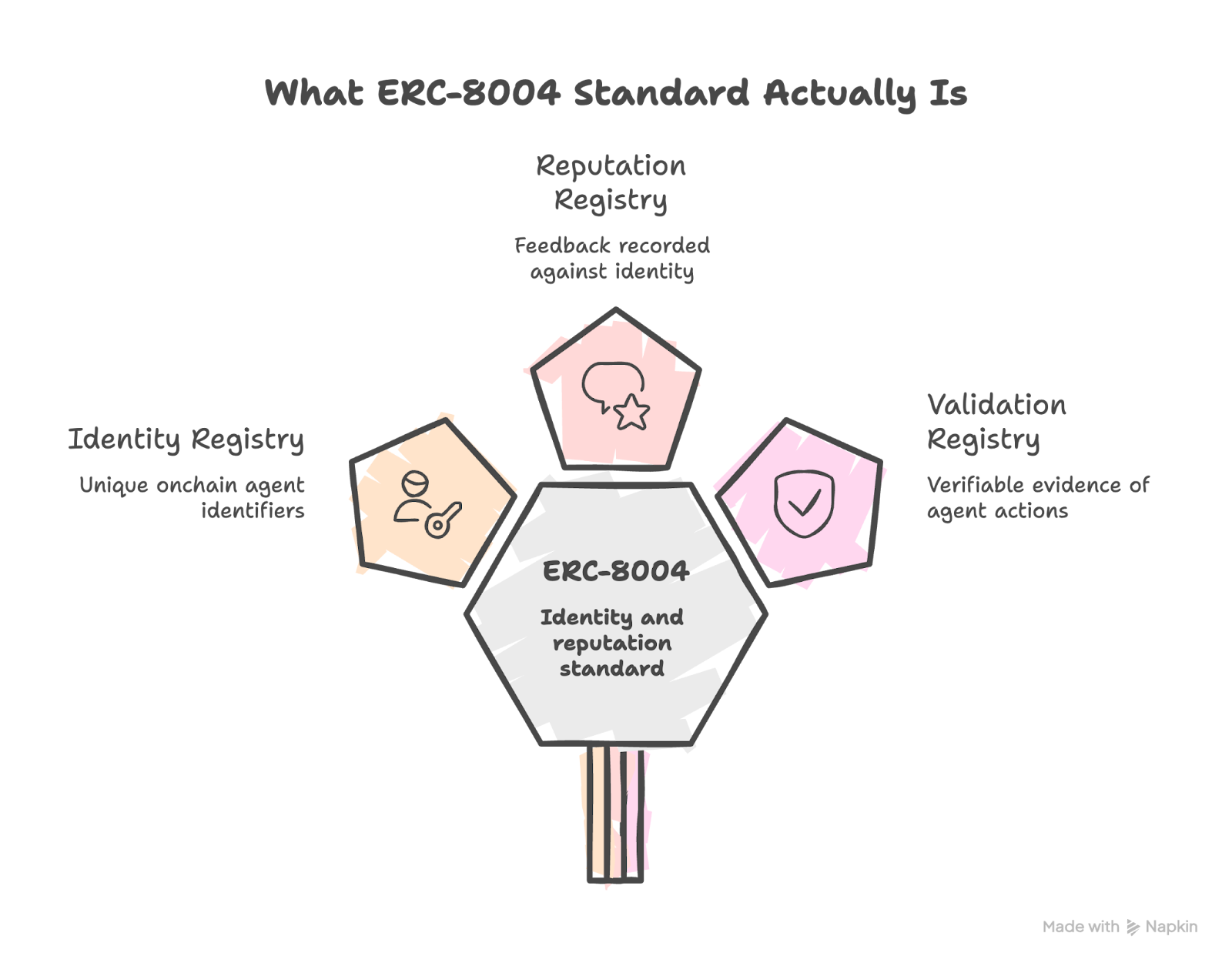
In practice, this means,
- Agents can discover and interact with other agents based on verified capabilities.
- Protocols can enforce permissions and trust boundaries automatically.
- Reputation can accumulate over time as agents participate in economic activity.
Now, we have a way to answer who an agent is and what it is allowed to do. Next, we evaluate AI agents’ ability to pay and get paid autonomously.
Payments: Stablecoins as Machine Money
It is simple. For an AI agent to operate autonomously, it must be able to hold value, send payments, receive payments, and settle transactions.
All of this needs to happen without relying on a human-owned bank account or payment processor.
Stablecoins pop up as a tailor-made solution for this situation.
Stablecoins like USDC and USDT, pegged to fiat currencies, allow agents to hold assets directly in wallets and transact with other agents programmatically.
This way, agents can:
- Pay for services or data feeds in real time
- Deposit and invest in protocols and vaults
- Receive payments for executing tasks
- Automate cross-border payments for corporations
Also, the above use cases aren’t theoretical possibilities. To date, stablecoins have processed trillions of dollars in onchain transaction volume and are increasingly used for global settlement, treasury management, and digital commerce.
They truly fulfill the gap in the AI agent tech stack as machine-native money.
Identity and stablecoins solve two-thirds of the problem. An agent can now prove who it is and hold value. What’s the next gap?
For a complete machine economy to form and function, agents need to coordinate actions and enforce agreements. How’s the AI agent stack faring in this area?
x402 + Blockchain Enable Trustless Coordination Between AI Agents
Economic systems and markets always need a rule enforcer between the parties. Entering into agreements, triggering actions, enforcing payments, etc need a coordination layer.
Traditionally, this is enforced in different ways within the business spectrum.
From regulatory bodies and institutions framing the rules and policies to human arbitration and customer support, there are several layers of coordination present.
This stack does not work for autonomous agents. They need deterministic rules and automatic enforcement.
For the machine economy, there are 2 key coordination fulcrums:
- Smart contracts act as programmable agreements that execute exactly as written once predefined conditions are met.
- x402 enables programmable machine-to-machine payment flows at the HTTP layer.
Together, these mechanisms create a trust-minimized coordination environment where agents can interact without needing to trust each other directly.
This way, agents can:
- Trigger protocol actions based on predefined rules
- Settle conditional payments tied to task completion
- Coordinate complex economic workflows without humans
Where we stand now
What x402 establishes, combined with ERC-8004 and stablecoins, is an agent that can identify itself, hold value, discover a service it has never used, pay for it autonomously, and receive what it paid for.
An end-to-end process without a human in the loop.
Together, these layers form the foundation of the AI agent blockchain stack i.e. the infrastructure that makes the machine economy operational.
Machine Economy is Only Possible on Blockchain
ERC-8004 gives agents an identity. Stablecoins give them money. x402 gives them a payment protocol.
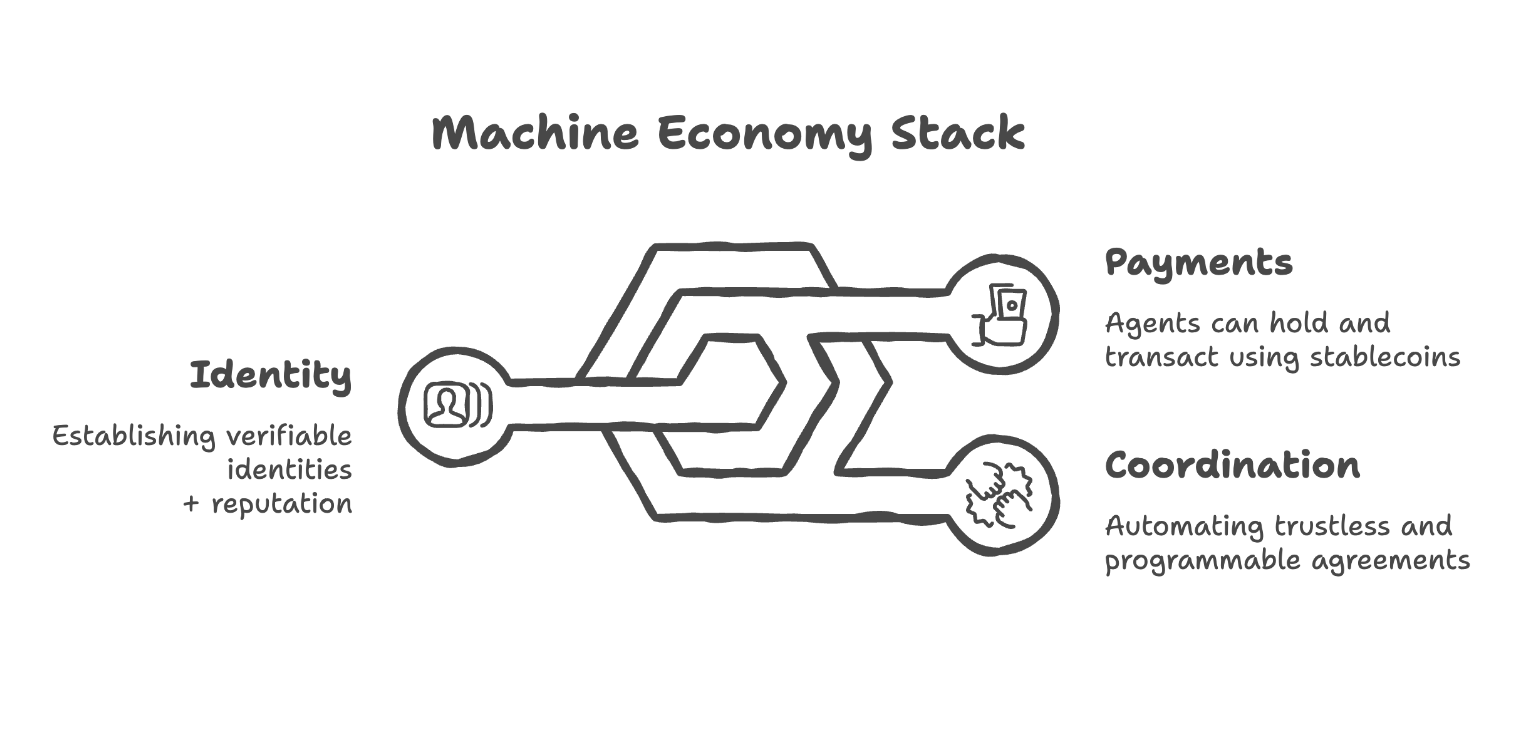
Three layers, three standards, three development tracks and timelines. The most obvious question: what holds them together to form the machine economy?
Imagine stitching these three layers together on traditional rails and see how quickly AI agents hit the wall.
- Identity requires a platform to authenticate it,
- Payments require a legal entity at each end,
- Coordination requires trust in a central operator.
Every tangent reintroduces a human gatekeeper.
Blockchain eliminates all three failure points simultaneously not because it is faster or cheaper, but because of its inherent properties:
- Permissionless participation
- Programmable trust
- Composability
- Auditability
The exact properties that let non-human economic actors operate independently without needing a human or platform deciding who gets access and on what terms.
Now, yes, the stack funnel is theoretically sound and it begins to look like a coherent infrastructure stack.
So, let’s get practical for the next question and explore how can a developer truly build on top of these primitives.
Inside the Emerging Infrastructure of the Machine Economy
The primitives exist. The standards are live. The question for a developer is concrete: what does it actually take to build on top of this stack?
Zoom out of the stack, we can see that once identity, payments, and coordination move onchain, the primary and critical infra requirement is a reliable, consistent, and low-latency access to blockchain data.
Without this, even the most capable agent cannot operate.
A key mental shift we need to understand is that,
- For human users, occasional latency or downtime is an inconvenience.
- For AI agents operating on pure code and logic, a single dropped RPC call can break the entire workflow.
Also, building in the machine economy requires infrastructure that was purpose-built for it. Why?
Because the requirements are extremely specific:
- AI trading agents managing a DeFi position across Morpho and Aave cannot wait for slow indexing.
- Agents need real-time access to all chains where ERC-8004 registries are present or where x402 payments settle.
- Agent marketplaces coordinating task payments via x402 need real-time verification of the payment condition before unlocking data access or service.
- Payment agents settling stablecoin transactions need deterministic confirmation tracking across multiple chains.
Each of these workflows depends on high-performance RPC access, real-time event streaming, and reliable cross-chain data availability.
And Quicknode is building for exactly this.
Where Quicknode Sits in the Machine Economy Stack
Quicknode provides the RPC access, data streams, and developer tooling that the machine economy stack runs on. Especially across 80+ blockchains where agents operate, at the latency and reliability that autonomous execution demands.
More specifically, here are some of Quicknode’s solutions:
- Agents querying ERC-8004 registry contracts need reliable RPC access and that's Quicknode's core infrastructure.
- On the execution side, the Quicknode MCP Server connects AI assistants directly to blockchain data: RPC endpoints, indexing, and streaming, without custom integration work.
- And Quicknode's x402 integration means agents can pay for RPC compute the same way they pay any other agent in the stack.
Beyond these solutions, Quicknode is also helping developers and teams exploring the machine economy:
- A collection of sample applications that developers can build and iterate. It spans x402 micropayments, AI-based DeFi yield optimizer, and more.
- For teams building agents at scale, Quicknode's professional services offer dedicated infrastructure support from architecture decisions to production deployment across the full agent stack.
Honestly, the AI agent and machine economy tech stack is assembling faster than most infrastructure cycles in web3 history. What’s next?
What Does Tomorrow's Machine Economy Look Like
Onchain primitives for AI agents' identity, payments, and coordination are converging rapidly into a coherent and reliable stack.
Its implications go beyond AI agents executing tasks more efficiently. This time, the machine economy stack will be
- Paying salaries
- Managing investments and trade positions
- Entering contracts and more.
These possibilities are genuinely expandable to one’s imagination.
Directionally, this is what the machine economy ultimately points toward: humans, institutions, and AI agents operating independently in a single economic system.
The infrastructure enabling that shift is still forming. But, the primitives are in place already.
And teams that build enterprise-grade solutions on top of these primitives are going to be the ones to build the most durable solutions.
The machine economy is here already. Build on it in the most reliable way possible.
About Quicknode
Founded in 2017, Quicknode provides world-class blockchain infrastructure to developers and enterprises. With 99.99% uptime, support for 80+ blockchains, and performance trusted by industry leaders, we empower builders to deploy and scale next-generation applications across Web3.
Start building today at Quicknode.com