Best Ethereum RPC Providers (2026): A Full Comparison
Compare the best Ethereum RPC providers in 2026. Learn what matters, how pricing works, and how to choose the right one.

Choosing an Ethereum RPC provider in 2026 is still more complex than it should be.
Not because the technology is immature, but because the critical evaluation criteria like features and pricing are often misunderstood.
This guide takes a developer-first approach:
- Clarifying the features,
- Showing how to calculate real costs, and
- Walking through the top five providers worth considering in 2026.
Once those are clear, the choice of Ethereum RPC provider becomes simpler. Let’s start.
Ethereum RPC Features: What Are They and What Actually Matters
Ethereum RPC providers surface a wide range of features, but most decisions come down to a small set of core variables that impact performance, reliability, and cost:
- Latency: Time for a node to respond to a request. Measured as p50, p95, or p99.
- Throughput: Requests per second a provider allows before rate-limiting kicks in.
- Uptime/SLA: Guaranteed availability, expressed as a percentage. 99.9% = ~8.7 hours of downtime per year. 99.99% = ~52 minutes.
- Archive vs Full Node Access: Full nodes hold recent state. Archive nodes hold all historical state from genesis.
- API Credits/Compute units (CUs): Unit for measuring request cost.
- Dedicated vs Shared Nodes: Shared nodes pool resources across customers. Dedicated nodes offer isolated and predictable performance.
- Compliance Certifications: SOC 2 Type II, ISO 27001.
These features set the baseline for picking an RPC provider.
Where teams consistently get caught off guard, however, is pricing. Specifically because of providers packaging and billing for these features in ways that make direct comparison harder than it needs to be.
So, let’s break down how to actually calculate RPC costs.
How to Actually Calculate Ethereum RPC Costs
Most Ethereum RPC providers price their services using a mix of:
- Requests
- Compute units (CUs) / API credits
- Tiered plans
At first glance, this seems comparable. In practice, it isn’t because of a simple problem: 1 request ≠ 1 request across RPC providers.
A lightweight call like eth_blockNumber and a heavy call like eth_getLogs are both single requests but on a CU-based model, they cost very different amounts.
So, what’s the way out?
Normalization Formula to Calculate Ethereum RPC Costs
The only way to compare providers is to normalize cost per actual method call:
- True cost per call = (CU weight of method × price per million CUs) ÷ 1,000,000
- Total cost = true cost per call × total call volume
- Monthly cost = true cost per call × monthly call volume
Where, cost per call = API credits or compute units (CU) consumed per method and this being specific to the provider.
A Working Example of Calculating Ethereum RPC Costs
Assume a DeFi app making 10 million eth_call requests per month across two providers:
Although it’s the same advertised price per million CUs, there is a 4x difference in actual spend, purely because of method weighting.
Now that the terminology is clear and cost can be normalized across providers, the comparison becomes much more straightforward.
Here’s how the top Ethereum RPC providers in 2026 stack up across these same variables.
True Cost Per 1M Calls: Ethereum RPC Providers Compared
The following table applies the normalization formula to five of the most-used Ethereum RPC methods across every provider in this comparison. Prices reflect each provider’s standard paid entry tier (not Enterprise) and are rounded for readability. Lower numbers are better.
*Infura note: Infura uses a daily credit quota rather than per-call billing. Effective cost depends on how fast the daily allotment gets consumed. debug_traceTransaction at 1000 credits per call will exhaust a Developer tier (15M credits/day) in 15,000 calls.
Ankr note: HTTP pricing shown. On gRPC (Premium plans), calls drop to 10 credits each for a 20x reduction.
Takeaway: Raw credit cost is only part of the picture. Quicknode delivers the most complete stack across every dimension that matters: competitive per-method pricing on the workloads Ethereum dApps actually run (eth_call, eth_getLogs, trace), the lowest latency in public benchmarks, the only full compliance posture in this comparison, and built-in Streams for workloads where polling would otherwise balloon cost. Other providers can look cheaper on paper for a single method, but none match Quicknode on production reliability, platform depth, or effective cost once real workload patterns and data infrastructure needs are factored in.
Quicknode: Most Complete and High-Performant RPC Stack
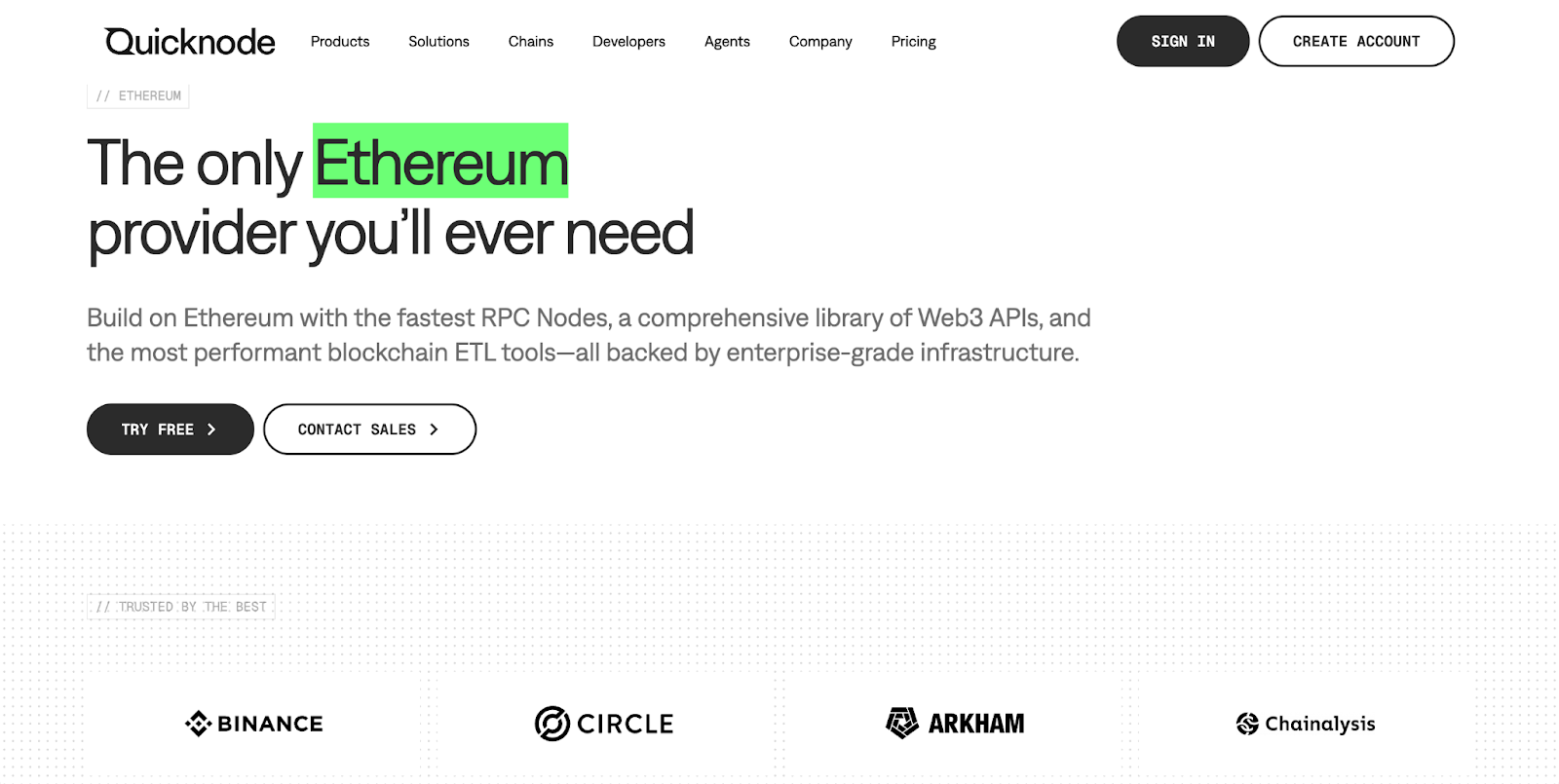
Quicknode has been building Ethereum RPC infrastructure since 2017. Today, QN is a global web3 infrastructure platform built on a 30+ region edge network with automatic failover and full archive access on every plan. What separates it from a pure RPC provider is the platform layer on top.
Streams for real-time data pipelines, and the most compliant RPC provider in this comparison.
What Quicknode Does Well
- High-performant and reliable infrastructure
Quicknode is designed to hold p95/p99 latency and avoid aggressive throttling even under traffic spikes, uneven workloads, or blockchain congestion.
All the claims of 99.99% uptime are backed by Quicknode’s contractual SLAs.
- Archive and trace access without the paywall
Full historical state is available on every plan, including free. Trace and debug APIs — debug_traceTransaction, trace_block, the full suite — are accessible on all paid plans at 2× the standard credit rate.
- Streams handles all things onchain data
Streams handles real-time onchain data delivery — filtered, pushed, with backfill and reorg handling built in — to PostgreSQL, Snowflake, S3, or a webhook.
This workflow of Streams + webhooks practically changes production costs: less polling, fewer redundant calls, and lower API credits or CU burn over time.
- Method-level pricing that aligns with dapps behaviour
Most Ethereum applications are read-heavy with eth_call, eth_getLogs, eth_getBalance being the usual workhorses.
Quicknode's method-level weighting tends to accommodate this well, resulting in lower effective cost once usage is normalized.
Performance in Practice (QuickLee Benchmark)
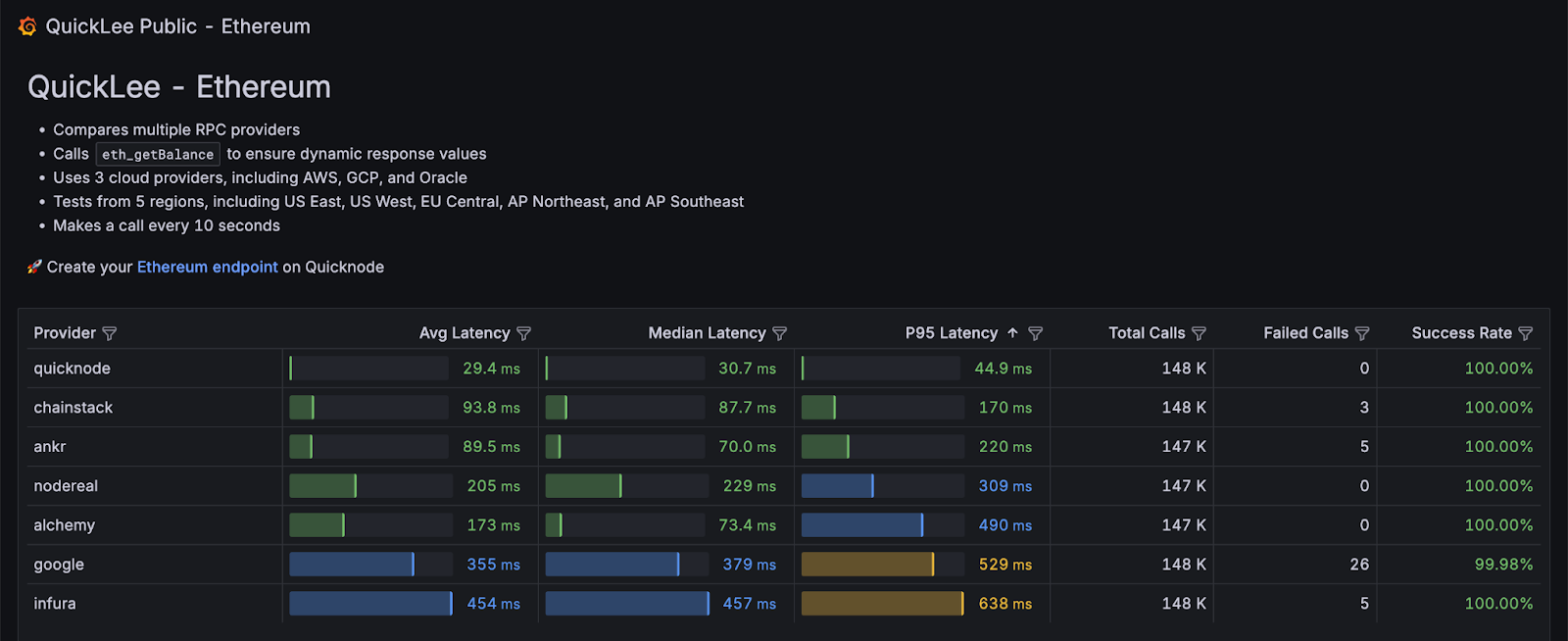
QuickLee is Quicknode's public benchmarking dashboard. It runs eth_getBalance every 10 seconds across five regions on AWS, GCP, and Oracle.
And Quicknode leads across all latency bands:
- Avg latency: ~29 ms
- Median latency: ~30 ms
- P95 latency: ~45 ms
- Failed calls: 0 (across ~148K requests)
This is where Quicknode's speed and consistency shines and proves reliable for enterprise-grade applications and products.
Quicknode and Compliance
Quicknode is,
- SOC 1 Type II, SOC 2 Type II, ISO 27001 compliant
- GDPR-ready infrastructure
- 99.99% uptime SLA (enterprise tiers)
The compliance was audited by Grant Thornton and recertified in Q1 2026. No other provider in this comparison holds all three simultaneously.
Developer Experience of Quicknode
Setup is straightforward and endpoint provisioning is immediate and Ethereum tooling (Ethers.js, Web3.js, Foundry, Hardhat, Viem) works out of the box.
Where Quicknode stands out is after initial integration.
As applications grow, teams typically need filtering, retries, data pipelines, and debugging infrastructure.
- Streams and webhooks reduce the need to build these layers separately.
- Documentation is extensive, with production-focused guides rather than just API references.
Alongside, Enterprise tiers include dedicated support and faster response times during incidents.
Quicknode Ethereum RPC Pricing
Quicknode bills on API credits.
Overage runs $0.62/1M credits on Build down to $0.50/1M on Business. Additionally, annual billing saves 15% across tiers.
Bonus: Quicknode in March 2026 launched Flat Rate RPS, starting at $799/month for 75 RPS on EVM chains.
This comes with a fixed monthly cost and no credit metering or overage risk.
Who is it for? Flat Rate RPS is purpose-built for high-volume workloads like trading bots which require continuous polling and latency-sensitive pipelines.
Considerations
- Debug and trace methods are billed at 2x the standard credit rate. This reflects the real infrastructure cost of archive and trace operations and is transparent on every plan, but teams running heavy trace workloads should factor the multiplier into their cost projections.
- Method-level credit weighting can look higher at a glance than simpler flat-cost models. Once normalized against real dApp traffic patterns, which are read-heavy and eth_call-dominant, Quicknode typically comes out lower in effective cost than the on-paper alternatives.
Best for
Any production workload where reliability, platform depth, and compliance are non-negotiable. Enterprise and regulated applications, trading infrastructure, real-time data pipelines, NFT platforms, and any team that expects to scale beyond prototype without swapping providers.
We have covered all things Quicknode. Let’s move onto other Ethereum RPC providers.
Alchemy
Alchemy is a popular Ethereum RPC provider, known for its enhanced APIs, transaction simulation, and the most generous free tier in this comparison.
What Alchemy Does Well
- Enhanced APIs: NFT, token, transaction simulation, and wallet activity APIs are production-ready out of the box.
Teams that would otherwise build custom indexers get this included.
- Generous free-tier: The free tier is genuinely useful, offering 30M CUs/month — roughly 1.15M eth_call requests at 26 CUs each.
The most accessible entry point of any provider here.
- Strong developer support: Alchemy's dashboards, SDKs, developers resources, and debugging tools are well-polished and easy to adopt.
Alchemy Ethereum RPC Pricing
However, CU weighting does lean towards the more expensive side at Alchemy.
For instance, eth_getLogs at 60 CU and debug_traceTransaction at 40 CU are expensive relative to peers and can penalize log-heavy workloads.
Tradeoffs to consider
- CU weighting penalizes data-heavy workloads. eth_getLogs at 60 CU and debug_traceTransaction at 40 CU run expensive relative to real dApp traffic patterns. Log-heavy or trace-heavy applications will see effective cost climb quickly.
- Incomplete compliance posture. SOC 2 Type II only. No SOC 1, no ISO 27001. Not a fit for regulated fintech, payments, or enterprise deployments that require the full compliance stack.
- No dedicated node access. Teams that need isolated performance guarantees for trading or high-throughput workloads have to look elsewhere.
- No real-time data primitives. No Streams-equivalent for pushed onchain data. Teams needing filtered real-time delivery end up building indexing and webhook infrastructure themselves.
Best for
Prototyping and early-stage NFT or token projects that can work within a single-certification compliance model and do not yet need dedicated nodes or production-grade data infrastructure.
Infura
Infura, by Consensys, is one of the earliest Ethereum RPC providers and remains deeply integrated with the ecosystem, powering apps like MetaMask.
What Infura Does Well
- Deep Ethereum familiarity: Infura has been running Ethereum nodes longer than almost anyone.
They possess the operational depth and know-how to handle protocol upgrades, edge cases, reorg handling, and every other edge case.
- Daily quota resets: Quotas reset at 00:00 UTC rather than monthly. A traffic spike exhausts the day's allocation, not the month's.
For teams with unpredictable usage patterns, this is a structural advantage over monthly billing models.
- Predictable, credit-based pricing model: Infura uses a credit system similar to CUs, with clearly defined per-method costs.
This makes cost estimation straightforward.
Outside this, some tradeoffs to consider before opting Infura are the lack of data-layer primitives and compliance certifications.
Infura Ethereum RPC Pricing
Key method weights: eth_call = 80 credits, eth_getLogs = 255 credits, debug_traceTransaction = 1000 credits.
Note: debug_traceTransaction at 1000 credits per call is significantly higher than peers.
Any workload with meaningful trace or debug volume will hit quota fast.
Tradeoffs to consider
- Trace workloads are prohibitively expensive. At 1000 credits per call, debug_traceTransaction will exhaust a Developer daily quota in 15,000 calls. A hard blocker for analytics, indexers, or any application that needs trace at production volume.
- No data-layer primitives. No Streams, no Webhooks, no built-in indexing. Teams building real-time applications construct this entire layer themselves.
- No compliance certifications. No public SOC 2, SOC 1, or ISO 27001. A blocker for regulated applications.
- Limited dedicated node options. No self-serve isolated infrastructure for teams that outgrow shared resources.
Best for
Legacy MetaMask-adjacent tooling and small workloads with unpredictable daily spikes. Not recommended for trace-heavy applications, regulated environments, or teams that will scale into production data pipelines.
Ankr
Ankr offers a decentralized Ethereum RPC infrastructure with the simplest cost model of any provider in this comparison.
What Ankr Does Well
- Cost-efficiency: Ankr’s pricing is generally on the lower end, making it suitable for early-stage teams optimizing for cost or non-critical workloads.
- API via gRPC: gRPC cuts per-call cost dramatically on Premium plans.
HTTP calls cost 200 credits each. gRPC method calls cost 10 credits per call which is a confirmed 20x reduction.
For high-volume workloads, this changes the unit economics significantly.
Ankr Ethereum RPC Pricing
Ankr offers very limited built-in support for streaming, indexing, or event-driven workflows. And there's no SOC 2 or similar compliance documentation.
Tradeoffs to consider
- No built-in data infrastructure. No streaming, no indexing, no event-driven workflows out of the box. Teams requiring real-time data delivery engineer it themselves.
- No compliance documentation. No public SOC 2, SOC 1, or ISO 27001. Not suitable for regulated deployments or enterprise applications.
- SLA inconsistency across tiers. Uptime commitment ranges from 99% on lower tiers up to 99.99% only on Enterprise. Production workloads should verify guarantees carefully before committing.
- gRPC is the only way to get competitive cost. HTTP pricing at 200 credits per call is high relative to the market. The 20x gRPC discount is only on Premium and requires teams to handle gRPC integration themselves.
Best for
Non-critical or experimental workloads where budget is the primary constraint and teams are comfortable building data, compliance, and reliability layers on top.
Chainstack
Chainstack is a unique Ethereum RPC provider leaning heavily towards giving teams more direct ownership over nodes, regions, and scaling behavior.
What Chainstack Does Well
- Pricing is simpler and more predictable: 1 RU per standard call, 2 RU per archive or debug call. That's the entire pricing model.
This removes the guesswork around method-level weighting.
- Dedicated nodes are self-serve: Dedicated nodes, unlimited nodes, and geo-balanced deployments are built into higher tiers, making it easier to transition.
- Granular control over deployment: Multi-cloud (AWS, GCP, Azure) and regional placement options allow teams to colocate nodes with their apps.
This materially improves latency and reliability.
The pricing transparency and deployment flexibility comes with their tradeoffs:
- Teams need to think more about architecture (regions, node types, scaling).
- Performance depends more on configuration choices.
Apart from these, Chainstack provides fewer built-in data primitives compared to peers.
Chainstack Ethereum RPC Pricing
Two points to note:
- Overage ranges from $20/1M RU (Developer) down to $5/1M RU (Enterprise).
- Annual billing saves 16%.
Additional tradeoffs to consider
- No archive access on the free tier. Archive queries require a paid plan. Teams prototyping with historical data have to upgrade earlier than with other providers.
- No real-time data primitives. No Streams-equivalent for pushed onchain data, no pre-built data APIs. Teams that need real-time delivery engineer it themselves on top of the RPC layer.
- More operational overhead. The deployment control surface (regions, node types, scaling) means teams take on more architecture decisions and ongoing configuration responsibility.
Best for
Teams that have the in-house engineering capacity to manage deployment architecture themselves and want granular control over regional placement and multi-cloud configuration.
Now that we have covered all 5 top Ethereum RPC providers in detail, let’s see how they stack against each other.
Top 5 Ethereum RPC Providers at a Glance
The table below normalizes the five providers across the variables that actually affect cost, reliability, and architecture decisions.
Which Ethereum RPC Provider for Your Use Case?
Different workloads have different priorities. Here’s how the top providers map to common use cases.
DeFi protocols and trading bots
Quicknode, Chainstack. Both offer low-latency WebSocket and dedicated node options for trading workloads. Quicknode leads on measured performance, holding ~29ms average and ~45ms p95 in public QuickLee benchmarks with zero failed calls across 148K requests. Method weighting favors eth_call-heavy patterns, and Flat Rate RPS (from $799/month for 75 RPS) removes overage risk entirely for continuous polling and arbitrage workloads.
NFT platforms and wallets
Quicknode, Alchemy. Both provide enhanced APIs and archive access relevant to NFT workloads. Quicknode pairs archive on every plan (including free) with production-grade add-ons for indexing, metadata, and media delivery, plus Streams for real-time mint and transfer tracking without custom indexers.
Enterprise and regulated applications
Quicknode. SOC 1 Type II, SOC 2 Type II, and ISO 27001, audited by Grant Thornton and recertified in Q1 2026. Quicknode is the only provider in this comparison that holds the full compliance stack, backed by 99.99% contractual uptime SLAs on enterprise tiers. For fintech, payments, and regulated deployments, the compliance posture is the deciding factor.
Early-stage teams and startups
Quicknode, Alchemy, Ankr. Alchemy and Ankr offer generous free tiers for pre-revenue prototyping. The Quicknode Startup Program goes further: qualifying startups get substantial credit grants, dedicated onboarding, technical support from the same engineers who serve enterprise customers, and access to the full platform (Streams, archive, trace, add-ons) from day one. Prototypes built on Quicknode scale into production without changing providers, which saves months of re-engineering work once the application grows.
High-volume data pipelines and indexers
Quicknode Streams, Ankr gRPC. For teams comfortable with gRPC, Ankr’s Premium gRPC endpoints offer a 20x per-call discount vs HTTP. Quicknode Streams takes a different approach: real-time filtered data delivery to PostgreSQL, Snowflake, S3, or a webhook with backfill and reorg handling built in. For most pipeline workloads, replacing polling with push-based delivery reduces redundant calls, engineering overhead, and effective cost more than any per-call discount can.
Cross-chain and multi-chain applications
Quicknode. Single-provider coverage across 60+ chains means one platform for auth, billing, monitoring, and compliance. Teams building multi-chain applications avoid the operational overhead of managing multiple RPC relationships and the reliability risk of mixed infrastructure quality.
Frequently Asked Questions (FAQs)
- Which is the best Ethereum RPC provider?
Quicknode is best suited for production workloads due to consistent latency, reliability under load, and built-in data infrastructure like Streams and Webhooks.
- What affects RPC performance the most?
Latency consistency (p95/p99), rate limits, and infrastructure quality matter most. Quicknode is optimized to maintain stable performance under real-world conditions.
- Do I need a dedicated node, or can I use a shared RPC provider?
For most applications, RPC providers like Quicknode offer the best in-class performance and reliability at a lower cost. Dedicated nodes are necessary for high-frequency trading, applications requiring guaranteed uptime SLAs above 99.99%, or workloads exceeding 100M+ requests per month.
- What is the cheapest Ethereum RPC provider in 2026?
The cheapest sticker price is rarely the cheapest total cost. Effective cost is determined by method weighting against real workload patterns, how much polling and indexing infrastructure you have to build yourself, and what uptime and reliability cost you in production incidents. Quicknode’s method weighting favors the eth_call-heavy patterns most dApps actually run, and Streams replaces polling workflows that burn credits on cheaper-looking providers. For high-sustained-throughput workloads, Flat Rate RPS ($799/month for 75 RPS) delivers predictable cost with no overage, and is often lower effective cost than any credit-based plan once sustained throughput exceeds roughly 50M calls/month.
- How do compute units affect Ethereum RPC pricing?
Compute units (CUs) or credits are how providers measure request cost. A lightweight call like eth_blockNumber and a heavy call like eth_getLogs are both one request but cost different amounts of CUs. Two providers advertising the same $10 per 1M CUs can produce a 4x difference in actual monthly spend because of method weighting. The only reliable way to compare is to normalize: (CU weight of method × price per million CUs) ÷ 1,000,000, multiplied by monthly call volume. Quicknode’s weighting is tuned to real dApp workloads, which is why effective cost is typically lower than the advertised per-million price suggests.
- Which Ethereum RPC providers are SOC 2 certified?
Quicknode (SOC 1 Type II, SOC 2 Type II, ISO 27001), Alchemy (SOC 2 Type II), and Chainstack (SOC 2 Type II) hold public compliance certifications. Infura and Ankr do not publish SOC 2 documentation. For regulated applications in fintech, payments, or enterprise deployments, Quicknode is the only provider in this comparison with all three major certifications, audited by Grant Thornton and recertified in Q1 2026.
- Do I need archive node access for my Ethereum dApp?
Archive access is required whenever historical state from before the most recent ~128 blocks is needed. Use cases that require it: analytics dashboards, block explorers, tax and accounting tools, historical balance queries, and any app computing state from before a given block. Full nodes (recent state only) are sufficient for most DeFi swaps, wallet balance checks, and transaction submission. Quicknode includes archive access on every plan, including free. Chainstack requires a paid plan for archive access.
- What is the best Ethereum RPC provider for trading bots?
Trading bots demand consistent low latency, high sustained throughput, and predictable cost at scale. Quicknode is purpose-built for this: public QuickLee benchmarks show ~29ms average latency and ~45ms p95 with zero failed calls across 148K requests, which is the lowest latency profile of any provider in this comparison. For sustained polling workloads, Flat Rate RPS (from $799/month for 75 RPS) eliminates credit metering entirely. For credit-based usage, the Build and Accelerate tiers combine competitive pricing with the same underlying infrastructure, so bots scale from prototype to production without swapping providers.
- How do I switch Ethereum RPC providers without downtime?
Run both endpoints in parallel before cutting over. Most Ethereum clients (Ethers.js, Web3.js, Viem) support fallback providers or provider arrays. Set the new provider as the primary and the old one as the fallback, monitor error rates and latency for at least 24 hours, then drop the old provider. Key checks during transition: method compatibility (custom or enhanced APIs may not be portable), WebSocket reconnection behavior, and rate limit differences that could affect bursty workloads.
About Quicknode
Founded in 2017, Quicknode provides world-class blockchain infrastructure to developers and enterprises. With 99.99% uptime, support for 80+ blockchains, and performance trusted by industry leaders, we empower builders to deploy and scale next-generation applications across Web3.
Start building today at Quicknode.com.