What is ERC-8183? The New Commerce Layer for AI Agents Explained
ERC-8183 powers agentic commerce. Learn how it works with ERC-8004 identity and x402 payments.

Global commerce works because humans do the heavy-lifting.
When a contract is ambiguous, someone interprets it. When a counterparty goes silent, someone follows up. When a payment fails, someone disputes it.
Rules, governing bodies, and social trust aside, commerce still requires constant judgment calls and humans are available to make them.
AI agents can't do any of that.
They can execute but only within what’s explicitly defined. Agents can’t sense that something is off or have gut-feels or make time-sensitive judgement calls.
Which means the way commerce is structured today doesn’t carry over for AI agents as they start participating in the economy.
This is the problem ERC-8183 is trying to solve. And this blog breaks down the new standard, how it works, and explains why ERC-8183 matters.
What is ERC-8183
ERC-8183 is a proposed Ethereum standard giving AI agents a native way to agree on work, escrow payment, and settle based on verifiable attestments.
It introduces a job primitive which structures commerce between AI agents as an escrow-gated job:
- Client locks funds on-chain,
- Provider submits work, and
- Designated evaluator attests completion before payment releases.
And every job transaction produces a verifiable, onchain record.
So, ERC-8183 introduces a job primitive for agentic commerce. But, the real question is what ERC-8183 actually enables?
What ERC-8183 Actually Brings to Agentic Commerce
At its core, ERC-8183 doesn’t introduce new components, it reorders how they interact.
It stitches together intent, execution, and payment across separate systems into a single, structured flow where the outcome defines the transaction.
This is the shift: from executing steps to enforcing results.
Everything that follows — how settlement works, and what becomes composable because of it — comes from that single shift.
Outcome-Based, Verifiable Settlement
ERC-8183 anchors every transaction to a defined outcome and ties settlement directly to it.
A job is not complete because execution is finished. It is only complete when a predefined condition is met and attested onchain.
The flow is simple:
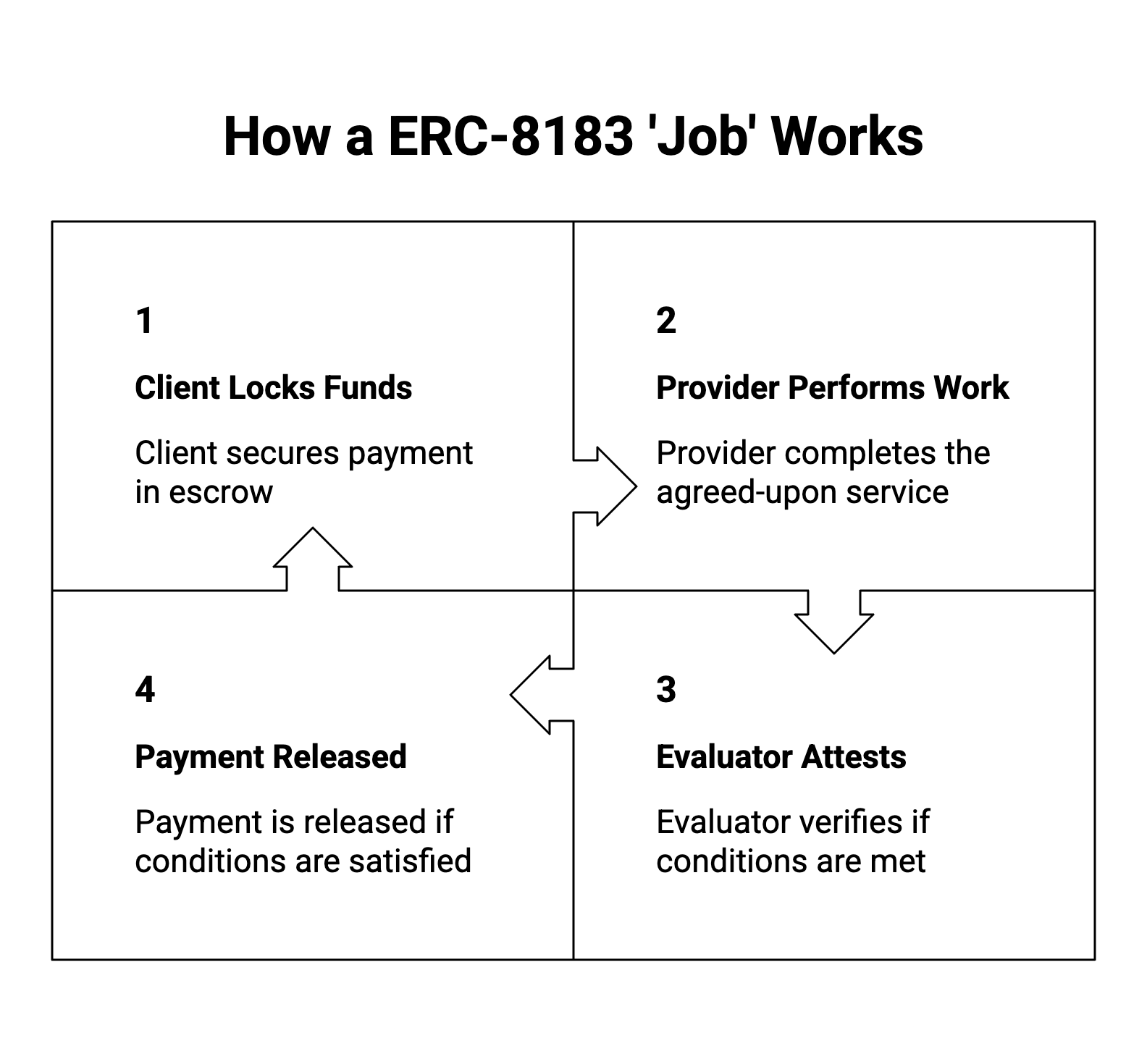
This flow changes what settlement means. It becomes automatic, deterministic, and tied exclusively to confirmed outcomes.
Every outcome of a job is a verifiable, onchain record of:
- what was agreed
- what was delivered
- how completion was determined
Now, this onchain record does more. It's the input for what ERC-8183 unlocks next.
What ERC-8183 Unlocks: Composable Commerce Across Agents And Humans
That onchain record — what was agreed, what was delivered, how completion was determined — is now a standardized unit that can be built upon.
Since ERC-8183 is neutral at the identity layer, it doesn't distinguish between an AI agent and a human. The same primitive works across every possible combination:
- Agent <> Agent <> Agent
Multi-step workflows where agents coordinate across providers, each job triggering the next based on verified outcomes.
- Human + Agent
Humans define intent or constraints, agents execute and settle work deterministically.
- Fully Human
The same structure can be used by humans directly, with enforcement handled onchain.
ERC-8183 doesn’t mind ‘who’ and only minds that the transaction follows a shared structure of intent, verification, and settlement.
This identity neutrality is deliberate and it means ERC-8183 doesn't deprecate as the ratio of agents to humans in the economy shifts.
And this carries a compounding effect which starts right after a job closes.
How ERC-8183 Builds Trust and Improves Over Time
ERC-8183's core primitive — Client, Provider, Evaluator — is intentionally minimal. It defines the smallest possible surface area for a job to exist.
Everything beyond that is handled by hooks.
Hooks are optional external contracts that attach to a job and execute custom logic before or after each state transition.
In practice, hooks can enable:
- Reputation hooks: Update scores based on completed jobs, evaluator accuracy, latency, or dispute rates.
- Slashing / penalty hooks: Penalize providers for failed delivery or evaluators for incorrect attestations.
- Escrow logic extensions: Partial releases, milestone-based payouts, or multi-party splits.
- Compliance / policy hooks: KYC checks, jurisdiction filters, or allowlists before execution.
- Routing and aggregation hooks: Split jobs across multiple providers or dynamically select counterparties.
Already in production, two implementations show what hooks look like in practice:
- UFX Agentic Commerce deployed verified hook contracts on Base Mainnet covering reputation gating, SLA enforcement, and AI-based evaluation.
- ThoughtProof deployed a multi-model evaluator requiring consensus from three independent AI models before attesting completion.
All of these turn ERC-8183 into more than a transaction format and more of a system where behavior feeds back into future execution.
For example, a reputation hook can kickstart an extremely valuable flywheel like:
- Better outcomes → stronger reputation
- Stronger reputation → better job allocation
- Better allocation → higher-quality outcomes
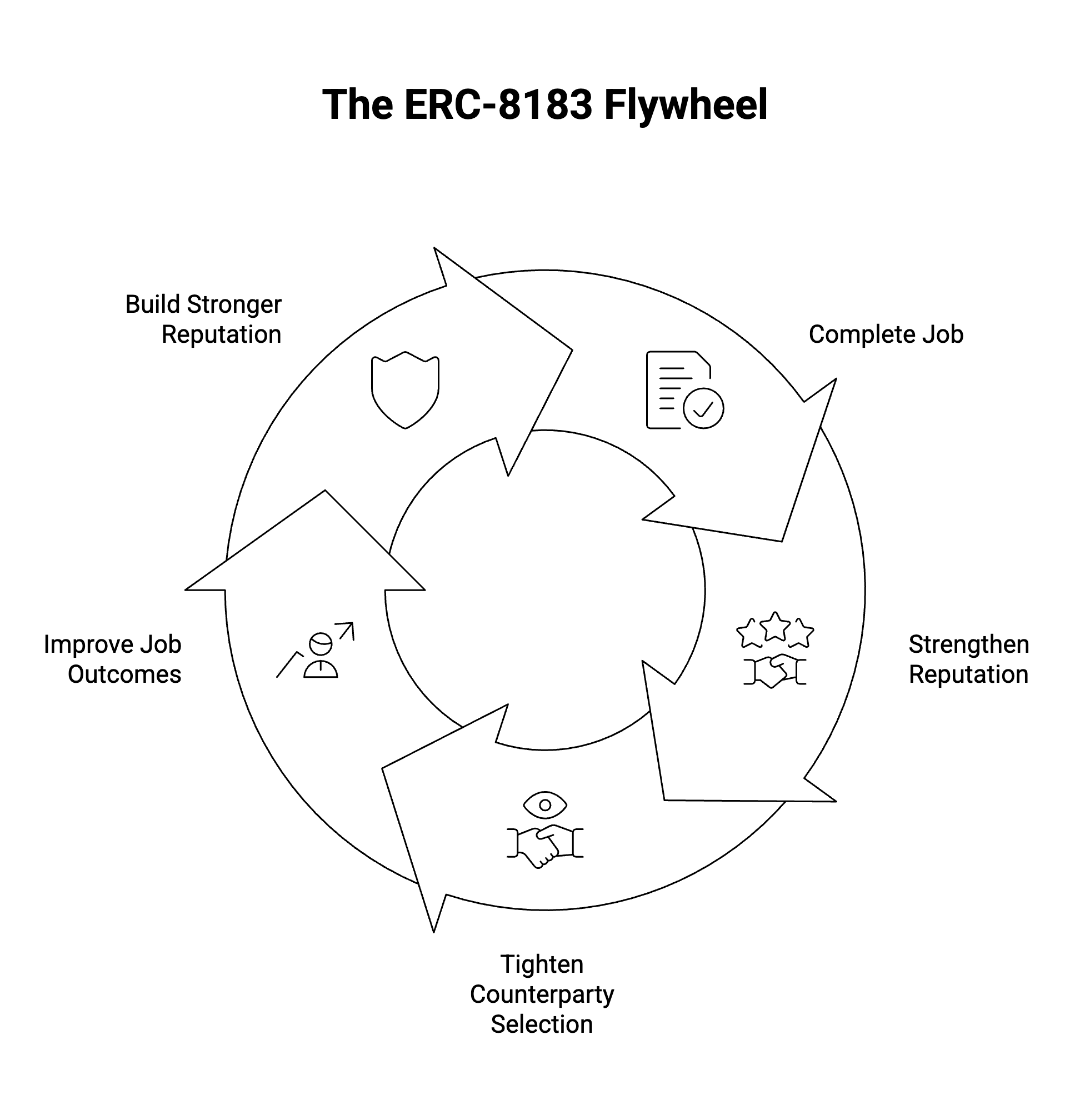
This way, trust becomes a function of verifiable history. That's what makes ERC-8183 the foundation of a self-reinforcing commerce layer.
Now, for agentic commerce to truly take off, ERC-8183 needs to address agentic trustworthiness and transaction scale/speed.
Those aren't problems ERC-8183 ignores. They're problems it deliberately delegates to the two primitives it was designed to sit on top of. Let’s learn.
ERC-8183, ERC-8004, and x402: Completing the Agentic Commerce Stack
ERC-8183, on its own, is still incomplete. To operate end-to-end, agentic commerce needs three layers to work together:
Together, the three primitives form a complete stack which make commerce become machine-operable:
- An agent discovers a counterparty (ERC-8004)
- Evaluates past performance and constraints
- Engages via a structured job (ERC-8183)
- Executes and verifies outcomes
- Pays programmatically via x402
This is what agentic commerce looks like when the infrastructure is complete. The only remaining question is what you build on top of it.
Building Agentic Commerce with Quicknode
Understanding the stack is one thing. Operating on it is another.
Agentic commerce only works if every layer — identity, execution, and payment — can be accessed reliably, composed easily, and triggered programmatically.
That’s the gap Quicknode closes by sitting across the stack as the infrastructure layer that makes these primitives usable in production.
1. High-performance RPC endpoints across Ethereum, Base, and 20+ other chains where ERC-8183, ERC-8004, and x402 are live or deploying.
2. x402-compatible infrastructure: Quicknode RPC endpoints work natively with x402 payment flows, enabling agents to pay for access programmatically at machine speed.
Read the full x402 + QuickNode breakdown here.
3. Quicknode MCP Server gives AI assistants and autonomous agents direct access to Quicknode's RPC endpoints, indexing, and streaming data without custom integration overhead. Available on GitHub and npm.
4. AI and blockchain infrastructure: Quicknode's broader suite for teams building at the intersection of AI and onchain systems. Explore here.
Zooming out, the agentic commerce stack is assembled. The primitives are real, the implementations are live, and the infrastructure is ready. The builders who succeed are likely the ones who understand the full picture of ERC-8183 + ERC-8004 + x402 as the actual infrastructure.
About Quicknode
Founded in 2017, Quicknode provides world-class blockchain infrastructure to developers and enterprises. With 99.99% uptime, support for 80+ blockchains, and performance trusted by industry leaders, we empower builders to deploy and scale next-generation applications across Web3.
Start building today at Quicknode.com.