The Quicknode ERC-8004 Stack: A Public Window Into Onchain Agents
Three new ways to build on ERC-8004: a multichain Explorer, an x402-native REST API, and a JSON-RPC add-on across 15 EVM networks.

AI agents are starting to act like economic participants. They call APIs, move stablecoins, coordinate with other agents, and increasingly, do it without a human pressing a button. The problem is that until recently, there was no standard way for an agent to prove who it is or carry a reputation from one app to another.
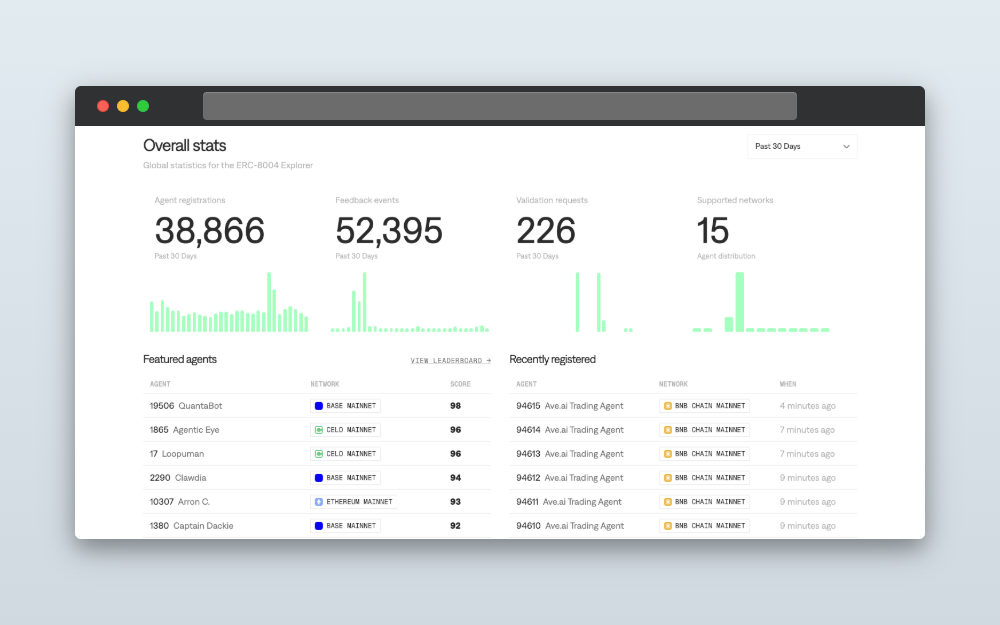
ERC-8004 fixes that. It went live on Ethereum mainnet in January 2026, and in its first 90 days the standard has logged close to 39,000 agent registrations and more than 73,000 feedback events across 15 chains. That is meaningful early traction for an identity standard.
We think this matters, so we built something to make it legible. Today we are launching the ERC-8004 Explorer: a public, multichain explorer for agent identity, reputation, feedback, and validation under the new standard.
What ERC-8004 actually does
ERC-8004 extends the Agent-to-Agent (A2A) protocol with a trust layer. It defines three lightweight onchain registries:
Identity. Every agent gets a unique onchain ID, minted as an ERC-721 token. The token's URI points to an offchain registration file containing the agent's name, capabilities, service endpoints, and payment address. The NFT is the canonical identity. There is no central registry.
Reputation. Clients submit feedback against an agent's ID with bounded numerical ratings and categorical tags. The standard does not prescribe a single scoring algorithm, which leaves room for an ecosystem of scoring services, auditors, and insurance pools to build on the same raw signals.
Validation. Independent validators can verify an agent's behavior using methods like cryptoeconomic staking, TEE attestations, or zero-knowledge proofs, and record the result onchain.
The architecture is deliberately minimal onchain and flexible offchain. The standard does not pick a payment system, but the spec explicitly references x402 as a complementary protocol for monetizing agent interactions.
The proposal was authored by Marco De Rossi (MetaMask), Davide Crapis (Ethereum Foundation), Jordan Ellis (Google), and Erik Reppel (Coinbase). That is not a coincidence. The agent identity problem cuts across wallets, foundations, AI labs, and payment companies, and ERC-8004 is the first standard with serious cross-org backing.
Why an explorer matters
A registry without a way to read from it is just a database nobody trusts. The whole point of ERC-8004 is that any agent, anywhere, can be looked up and evaluated by anyone. That requires three things that nobody had shipped yet:
- A neutral place to search across every chain where agents are registering
- A reputation score that is not a black box
- An API that fits how agents actually consume data, which is to say, no signup forms
The ERC-8004 Explorer is our answer to all three.
What is in the Explorer
Search and audit across 15 chains. You can search any agent by ID or address across Ethereum, Base, BNB Chain, Avalanche, Mantle, Celo, and more. Every registration, feedback event, validation request, and ownership transfer is indexed and queryable. You can browse the leaderboard, filter by network, or pull up a specific validator's track record.
A reputation score you can actually verify. The Explorer computes a composite reputation score for every agent. The formula is public. Weights, sub-scores, edge cases, all of it. We documented it at erc-8004.quicknode.com/reputation-v1 and every score can be replayed against the raw onchain events that produced it.
This matters because reputation systems are only useful if they cannot be gamed by whoever runs them. We did not want to ship a number you have to trust us on.
REST API priced over x402. This is the part we are most excited about.
The Explorer exposes a public REST API for agents, feedback, validations, and reputation. It is priced over x402, the HTTP-native payment standard that lets a client settle in USDC on a per-request basis without ever creating an account.
No API key. No signup. No rate-limit tiers. You pay for what you call.
This is what API distribution should look like for an agent economy. An agent that needs to check another agent's reputation before transacting with it should not have to register for an API key first. It should just pay a fraction of a cent and get the data. That is the model the explorer ships with.
The REST docs are at erc-8004.quicknode.com/docs/api/v1.
Quicknode JSON-RPC add-on. For teams that want ERC-8004 data inside their existing Quicknode infrastructure, we shipped an exclusive add-on. One JSON-RPC endpoint, 15 EVM networks, query ERC-8004 registrations, reputation, feedback, and validations alongside everything else you already pull from your endpoint.
If you are running production agents on Quicknode, this is the lowest-friction way to add identity and reputation lookups to your stack. You can enable it from the Quicknode Marketplace.
For Developers
If you're a developer building on ERC-8004, testing is currently a pain. There are no explorers for testnets, so it's hard to see the results of your work as you build. The ERC-8004 Validation Registry smart contract is also only deployed on testnets, with no way to visualize validation requests and responses. Our Explorer fixes that by letting you toggle testnet visibility, giving you the visibility you need to debug and ship.
The bigger picture
Quicknode has spent the last year going deep on agentic infrastructure: the substrate that AI agents need to operate as first-class economic participants onchain. That has meant shipping x402 support, the @quicknode/x402 npm package, MCP and MPP integrations, and the Blockchain Skills directory.
ERC-8004 slots into that thesis cleanly. Identity, reputation, and validation are foundational. If agents are going to transact with each other across organizational boundaries, they need a way to prove who they are and a reputation that follows them. The standard provides that primitive. The Explorer makes it usable.
We will keep shipping. Coming next: more granular reputation views, validator analytics, and additional chains as the standard expands.
In the meantime, the Explorer is live and free to use. Try it at erc-8004.quicknode.com.
About Quicknode
Founded in 2017, Quicknode provides world-class blockchain infrastructure to developers and enterprises. With 99.99% uptime, support for 80+ blockchains, and performance trusted by industry leaders, we empower builders to deploy and scale next-generation applications across Web3.
Start building today at Quicknode.com.