What is Lean Ethereum? A 5-Minute Explainer
Lean Ethereum explained: modular execution, proof-native verification, and Ethereum’s long-term direction. What changes and why it matters.

Ethereum’s core promise is a credibly neutral global computer.
Shared state and programmable execution anyone can access, verify, and build on without relying on a central operator or institution.
Almost 12 years and 25 million blocks later, the question of whether Ethereum can run stands voided.
The core promise, however, is now being pressured from three directions:
- Quantum computers that is challenging the underlying cryptography,
- Complexity ceiling that makes the protocol harder to verify and safer to centralize, and
- Throughput constraints that push activity into external environments like rollups.
Lean Ethereum promises to be the answer. Not as a siloed upgrade or an ERC standard but as a multi-year coordinated bet.
This piece explains what Lean Ethereum is, why it matters, what changes across for developers, and discusses if any attention is required today.
What Is Lean Ethereum?
Lean Ethereum is a 10-year coordinated rebuild to make Ethereum post-quantum secure, 10,000 TPS capable, and trustlessly verifiable by lightweight devices.
Two key parallels at work to make Ethereum lean:
- The roadmap narrows Ethereum’s priorities to its highest-value responsibilities: consensus and verification layer.
- Everything else — execution, state growth, proving — will be handled by modular systems secured by cryptographic proofs, verifiable at scale.
Coming back to the roadmap of Lean Ethereum, it is distributed across three layers:
- Lean Consensus: redesigning consensus for faster finality, post-quantum signatures, and simpler validator/client machinery.
- Lean Execution: making computation more proof-friendly while preserving full EVM compatibility.
- Lean Data: improving the data layer so rollups can scale on post-quantum-safe data availability.
Now, none of these new pieces make sense until and unless we understand where current Ethereum is lacking and why it needs a 3-layer redesign.
Why Ethereum Needs a Leaner Base Layer?
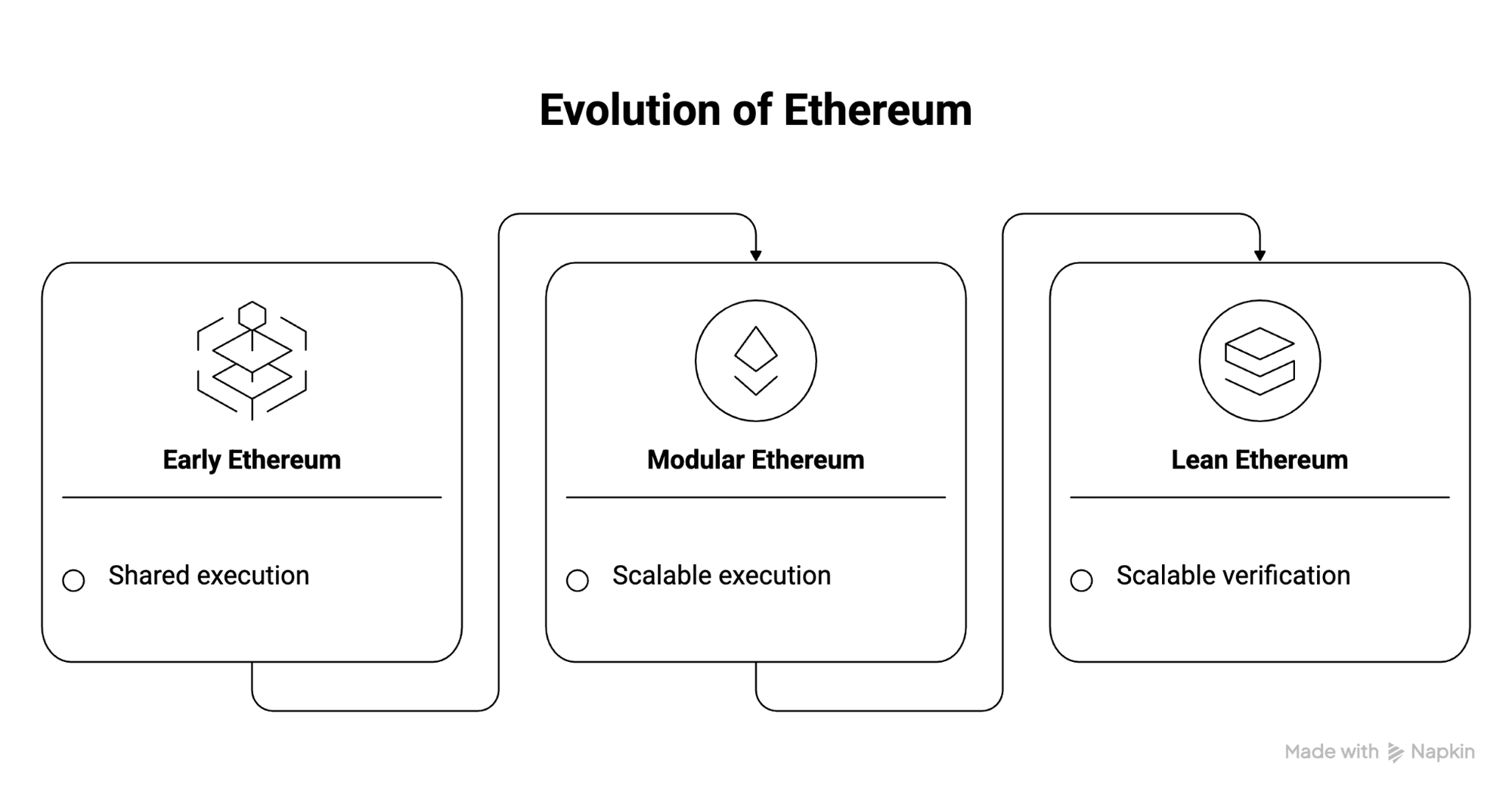
- Early Ethereum optimized for shared execution: every node ran every transaction, stored all history, and verified everything independently.
That design maximized decentralized access but it also meant verification costs scaled directly with network activity.
As Ethereum grew, this tradeoff became unsustainable.
- To scale Ethereum, execution increasingly moved into modular systems like rollups with the L1 as a settlement and data availability layer.
That shift solved throughput but introduced a new pressure: eroding decentralization.
Ethereum’s full-node chain data crossed ~1.58 TB in March 2026, growing ~25% YoY. During the same period, the gas limit increased from 36M to 60M per block.
Here, the risk is structural and evident: When verification becomes expensive, fewer people can verify Ethereum, and decentralization erodes slowly.
- Lean Ethereum steps in as the next evolution to keep decentralization operationally accessible.
The roadmap increasingly optimizes Ethereum around scalable verification:
- proofs instead of recomputation,
- modular execution, and
- cheaper independent verification.
Okay, Ethereum needs to reduce verification burden and avoid quiet centralization. How does Lean Ethereum aim to make this possible?
What Changes With Lean Ethereum?
Lean Ethereum aims to redesign every component around a stricter constraint: Ethereum will remain independently verifiable even as the network scales, threat models evolve, and infrastructure requirements increase over time.
The redesign is built on 3 distinct but coordinated layers:
- Lean Consensus reduces the cost and latency of coordinating validators.
- Lean Execution reduces the cost of verifying computation.
- Lean Data reduces the burden of publishing and verifying large-scale rollup data.
Let’s learn each layer individually.
Lean Consensus: Faster Finality and Post-Quantum Coordination
Lean Consensus redesigns Ethereum’s consensus layer around faster settlement, simpler validator coordination, and post-quantum-safe cryptography.
Ethereum’s current consensus system depends on BLS signatures for efficient validator aggregation and finality. The system works well today, but its cryptographic assumptions are not expected to survive sufficiently powerful quantum attacks over long time horizons.
The second shift is finality.
Today, bridges, intents, rollups, and cross-chain applications often operate around multi-minute settlement assumptions.
Faster finality compresses those trust windows and changes how developers think about interoperability, confirmations, and coordination across chains.
Lean Execution: Verifying Computation at Scale
Lean Execution explores how Ethereum can make computation cheaper to verify than to repeatedly re-execute across every node.
Today, Ethereum nodes independently execute transactions themselves to verify state transitions. The model is robust, but expensive at scale because verification cost grows with network activity.
This is where zkVMs, proof systems, and discussions around proof-friendly execution environments like RISC-V enter the roadmap.
Lean Data: Scaling Data Availability
Lean Data makes data availability cheaper to publish, easier to verify, and safer under long-term cryptographic assumptions.
Blob-based scaling already changed Ethereum’s economics by allowing rollups to publish data more efficiently without permanently storing all execution data.
The next challenge for Lean Data is to ensure Ethereum can verify large-scale data availability without any bandwidth, storage, and proof bottlenecks.
At this point, the architecture behind Lean Ethereum starts becoming clearer: Ethereum is no longer optimizing to directly execute everything on the base layer.
It is optimizing to verify increasingly large amounts of external computation, data, and coordination without sacrificing decentralization.
That shift has important downstream implications for developers. How does this look?
What Lean Ethereum Means for Developers
Simple answer: Lean Ethereum does not require immediate migration. However, Ethereum is increasingly optimizing for verification via its Lean approach.
This requires developers to rethink settlement, accounts, interoperability, infrastructure, and long-term protocol dependencies.
Here are 5 suggestions on how to navigate the interim phase of Lean Ethereum:
Verification becomes more important than execution
Applications increasingly run in external execution environments while Ethereum verifies correctness through proofs and settlement guarantees.
For developers, this means understanding — proof systems, zk-based verification, modular execution, and settlement design — becomes increasingly important even if applications still look EVM-compatible on the surface.
Finality assumptions become application-level design constraints
Multi-minute settlement assumptions affect:
- bridges,
- intents,
- cross-chain UX,
- MEV exposure,
- and interoperability design.
If Lean Consensus succeeds in compressing finality windows, user experience, trust assumptions, blockchain <> app coordination changes with it.
Smart accounts are a must-have
Lean Ethereum treats current cryptographic assumptions as replaceable infrastructure rather than permanent protocol primitives.
That makes flexible account abstraction structurally safer over long time horizons than wallets tightly coupled to a signature scheme or verification model.
Data availability becomes core infrastructure knowledge
Blob economics and data availability will increasingly determine:
- rollup costs,
- throughput,
- sequencing economics,
- and modular application architecture.
For many developers, understanding DA layers may become as operationally important as understanding gas markets on Ethereum L1.
Apart from all these, the most important tip is:
Avoid building around temporary constraints
Lean Ethereum is still a long-horizon research direction. Don't overthink migration or rebuilding of logic.
What developers need to prioritize is more flexibility and less hard-coding of monolithic execution, usual Ethereum latency, re-execution, and other facets.
The practical takeaway is to avoid designing systems that only work under today’s temporary architectural assumptions.
Now, where does Lean Ethereum stand? What’s the status? What’s live? And what can a developer do today?
Lean Ethereum Roadmap: Milestones and Timeline
Lean Ethereum is not a single upgrade arriving on a fixed timeline.
Different parts of the roadmap exist at very different stages of maturity, implementation readiness, and research confidence.
Some parts of the architecture are already live on Ethereum. Others remain active research directions that may evolve significantly before reaching mainnet.
Apart from this, Lean Ethereum runs across six sequential devnets before testnet. Each devnet adds a specific capability and the mainnet target is 2029–2030.
Moreover, eight independent client teams are currently running the spec across five languages: Rust, Zig, Go, C, and C++.
The important distinction is that Lean Ethereum is directionally real even where implementation details remain unsettled. Meaning, for developers, the signal is more about recognizing where Ethereum’s architecture is structurally heading.
What next?
Final Thoughts: Lean Ethereum Is Really About Trust Compression
Lean Ethereum is Ethereum reorganizing itself around the idea that verification is the real scarce resource in decentralized systems.
Computation is already abundant.
Rollups, zkVMs, coprocessors, and external execution environments can generate effectively unbounded activity outside Ethereum’s base layer.
What remains expensive is trust:
- independently verifying state,
- coordinating consensus safely,
- preserving decentralization,
- and keeping verification cheap enough that ordinary participants can still meaningfully audit the system.
That is why Lean Ethereum increasingly prioritizes proofs and modular execution.
All said, Ethereum is no longer optimizing to execute everything itself. It is optimizing so that everything can be trustlessly verified.
The next 25 million Ethereum blocks will be built on this thesis. And Lean Ethereum is the most deliberate attempt to make this possible.
About Quicknode
Founded in 2017, Quicknode provides world-class blockchain infrastructure to developers and enterprises. With 99.99% uptime, support for 80+ blockchains, and performance trusted by industry leaders, we empower builders to deploy and scale next-generation applications across Web3.
Start building today at Quicknode.com.